









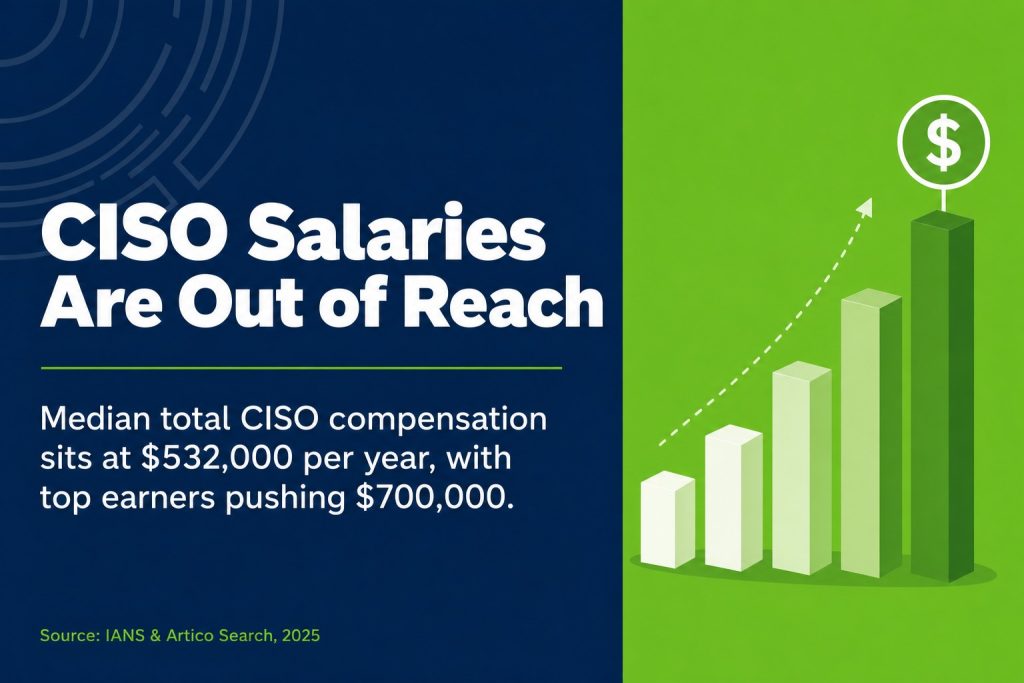
CISO as a Service (CISOaaS) is an outsourced model that gives organizations access to Chief Information Security Officer-level cybersecurity leadership on a flexible, subscription basis rather than through a full-time hire. A CISOaaS provider builds and manages your security program, leads risk management and compliance work, advises your board, and responds to incidents, at a fraction of the cost of an in-house executive. According to an IANS and Artico Search compensation report, median total CISO compensation sits at $532,000 per year, with top earners pushing $700,000. For most SMBs, that number alone closes the conversation on a full-time hire.
I’ve spent over 20 years in cybersecurity, including time as a corporate CISO, and the question I get most often from business owners isn’t “do we need security leadership?” It’s “how do we afford it?” That’s exactly the problem CISOaaS was built to solve. But the market is crowded and the terminology is a mess, so let’s cut through it.
What Is CISO as a Service (CISOaaS)?
CISO as a Service is a managed cybersecurity leadership model where an external provider delivers the strategic security functions of a Chief Information Security Officer without the organization hiring one full-time. The CISOaaS provider takes ownership of your security program, including policy development, risk assessment, compliance management, vendor oversight, and executive reporting.
This isn’t a monitoring tool or a help desk. CISOaaS is executive leadership. The provider sits where a CISO would sit: advising the CEO, briefing the board, owning the security roadmap, and making judgment calls during a crisis.
Most organizations using CISOaaS fall into one of two situations. They’re either too small to justify a $500,000 salary, or they’re growing fast and need security infrastructure before they can recruit one. Both are legitimate. Both are exactly what CISOaaS is designed for.
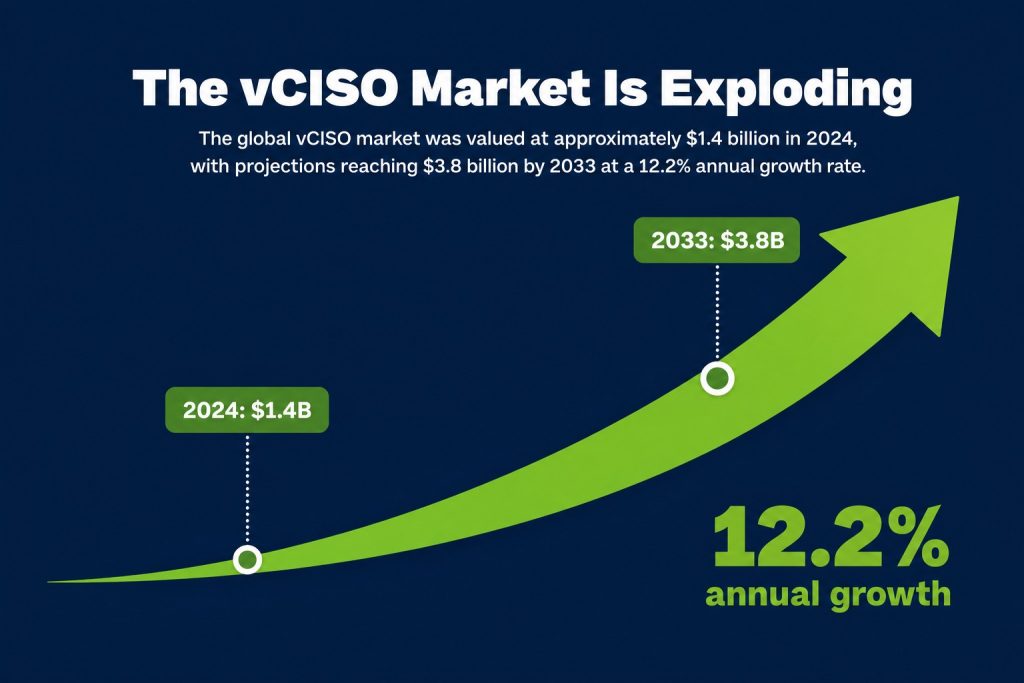
The global vCISO market was valued at approximately $1.4 billion in 2024, with projections reaching $3.8 billion by 2033 at a 12.2% annual growth rate. That kind of growth doesn’t happen without real demand behind it.
CISOaaS vs. Full-Time CISO: The Real Comparison
The most important difference between CISOaaS and a full-time CISO isn’t cost. It’s availability and accountability structure. A full-time Chief Information Security Officer is embedded in your organization, attends every leadership meeting, and builds institutional knowledge over years. A CISOaaS provider is engaged for defined hours or deliverables, and that scope shapes everything.
That said, the cost gap is hard to ignore. Research on CISO hiring timelines shows executive searches take a median of 107 days from launch to accepted offer. That’s three and a half months with no security leadership, and that’s before the ramp-up period. CISOaaS can be operational in days.
Here’s where the full-time model wins: a resident CISO builds deeper organizational context, responds faster in a crisis, and integrates more tightly with HR, legal, and operations. For organizations above a few hundred employees with mature IT infrastructure, a full-time hire often makes more sense long-term.
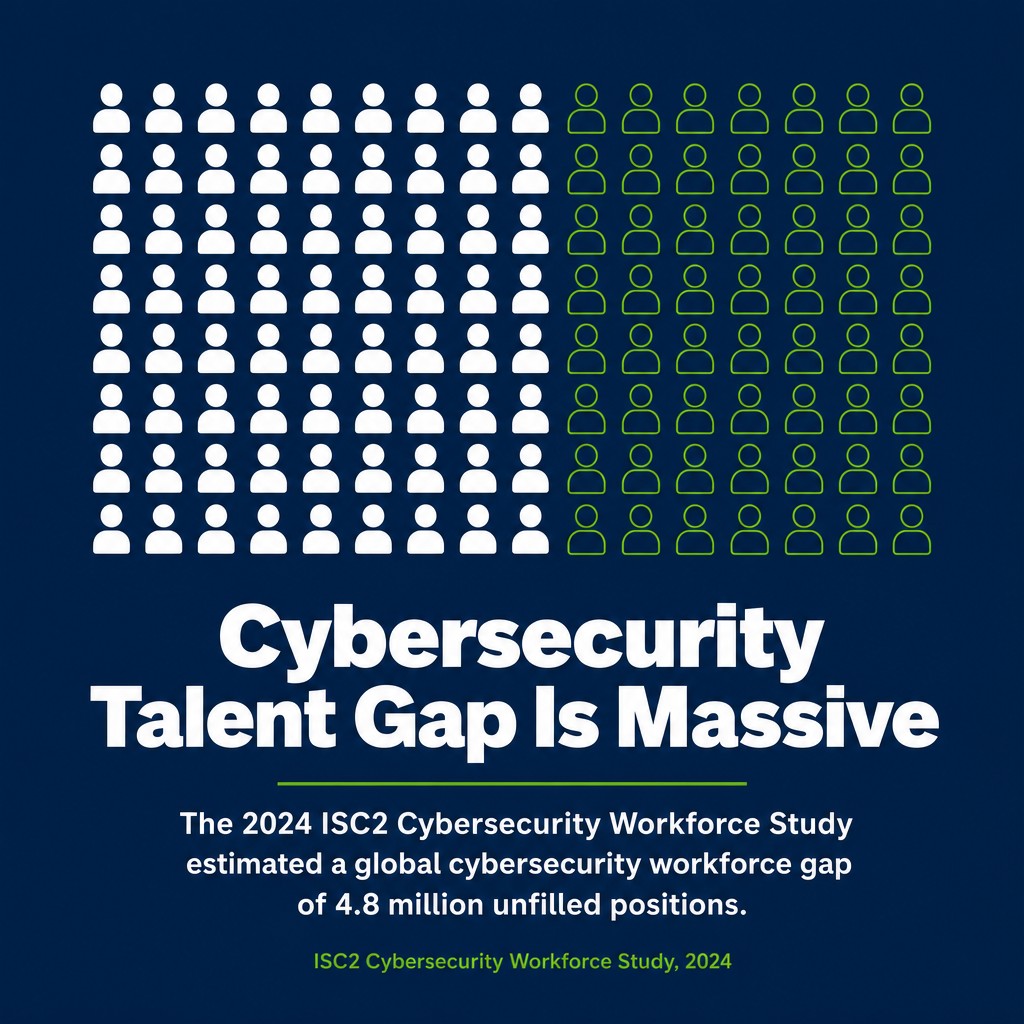
For everyone else, the math and the talent shortage both point toward CISOaaS. The 2024 ISC2 Cybersecurity Workforce Study estimated a global cybersecurity workforce gap of 4.8 million unfilled positions. You’re not just competing on salary. You’re competing against a market that doesn’t have enough qualified people to go around.
CISOaaS vs. vCISO vs. Fractional CISO: Sorting Out the Terms
CISO as a Service, virtual CISO, vCISO, and fractional CISO all describe outsourced security leadership, but providers use these terms differently, and the differences matter when you’re signing a contract.
Here’s how to read the terminology in practice:
- CISO as a Service (CISOaaS): The broadest term. Usually implies a managed service with defined deliverables, SLAs, and often a team behind the named advisor. The “as a Service” framing signals a structured, repeatable engagement model.
- Virtual CISO (vCISO): An individual operating remotely as your outsourced security leader. Often used interchangeably with CISOaaS, but the “virtual” label sometimes signals a solo practitioner rather than a firm.
- Fractional CISO: A senior security executive who splits their working hours across multiple clients. Typically more senior and more expensive per hour than a standard vCISO, but with fewer dedicated hours per month. Think part-time CFO, but for security.
In practice, many providers use all three terms to describe the same offering. What matters more than the label is the scope document: who does the work, how many hours per month, what’s included, and who’s accountable.
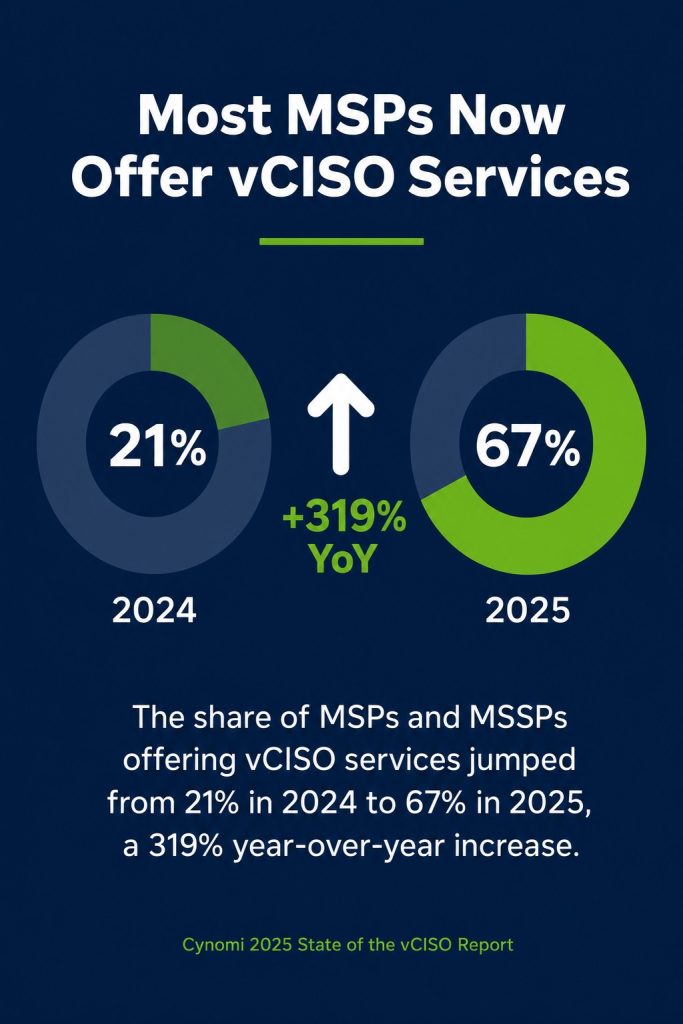
One thing worth noting: the share of MSPs and MSSPs offering vCISO services jumped from 21% in 2024 to 67% in 2025, a 319% year-over-year increase. The market is moving fast, and not every provider adding “vCISO” to their website has the depth to back it up.
Types of CISOaaS Engagement Models
CISO as a Service providers structure engagements in several distinct ways, and choosing the wrong model is one of the most common mistakes organizations make.
Individual Advisor Model
A single senior security professional serves as your outsourced CISO, typically for a set number of hours per month. This model works well for organizations that need strategic guidance and board-level communication but have an internal IT team handling day-to-day security operations. The advisor sets direction. Your team executes.
Team-Based Model
A security firm assigns a named vCISO supported by analysts, engineers, and compliance specialists. The named advisor handles leadership and communication. The team behind them does the technical work. This model scales better and covers more ground, but costs more and requires clearer coordination with your internal staff.
Project-Based or Interim Model
Some organizations bring in CISOaaS support for a specific purpose: SOC 2 certification, a post-breach recovery, a merger and acquisition security review, or CMMC compliance preparation. The engagement has a defined start, end, and outcome. This is the lowest-commitment option and often the right entry point for organizations that aren’t sure what level of ongoing support they need.
What CISOaaS Costs in 2026
CISO as a Service pricing in the U.S. market runs from $3,000 to $20,000 per month on retainer, according to current vCISO pricing data. Where you land in that range depends on the size of your organization, the complexity of your compliance requirements, the number of hours included, and whether you’re engaging an individual or a firm with a full team.
At the low end, $3,000 to $5,000 per month typically buys you a few hours of strategic advisory time, basic policy review, and monthly check-ins. That’s a starting point, not a security program.
At $10,000 to $20,000 per month, you’re getting meaningful engagement: ongoing risk assessments, compliance program management, incident response planning, board reporting, and often hands-on help from supporting analysts. That’s where CISOaaS starts to replace what a full-time hire would actually do.
Compare either number to that $532,000 median salary, plus benefits, equity, recruitment costs, and 107 days of vacancy. The economics of CISOaaS are not subtle.
Who Actually Needs CISO as a Service
CISO as a Service is not a fit for every organization, and overselling it does real damage. But for the right business, it’s one of the most practical security investments available.
The organizations that get the most value from CISOaaS share a few characteristics:
- SMBs with compliance obligations: SOC 2, ISO 27001, HIPAA, PCI DSS, or CMMC requirements demand documented security programs and evidence of governance. That’s exactly what CISOaaS delivers. Without it, most SMBs try to handle compliance through a checklist. Auditors can tell.
- Startups scaling toward enterprise customers: Enterprise procurement teams ask hard security questions. A CISOaaS provider helps you answer them credibly, build the policies and controls that actually back up your answers, and avoid losing deals over security questionnaires.
- Mid-market companies between IT and enterprise: You’ve outgrown “the IT guy handles security” but you’re not ready to staff a full security team. CISOaaS fills that gap without overhiring.
- Organizations after a breach or near-miss: Post-incident, you need someone who can assess damage, tighten controls, and communicate credibly to customers and regulators. CISOaaS providers do this regularly. Most internal IT teams do not.
The data backs up the demand. 57% of SMBs now rank cybersecurity as their top business priority in 2025. Priority doesn’t automatically translate into capability, and that gap is where CISOaaS does its best work.
What a CISOaaS Provider Actually Does
A CISOaaS provider takes on the full range of strategic security responsibilities a Chief Information Security Officer would own, scoped to the hours and deliverables defined in the engagement.
Core responsibilities typically include:
- Security program development: building or maturing your security policies, standards, and procedures from the ground up
- Risk assessment and risk management: identifying your threat exposure, building a risk register, and prioritizing remediation by business impact
- Compliance management: guiding your organization through SOC 2, ISO 27001, HIPAA, PCI DSS, CMMC, or other applicable frameworks
- Incident response planning: building a documented plan, running tabletop exercises, and leading the response when something actually goes wrong
- Vendor and third-party risk management: assessing the security posture of suppliers and partners who touch your data
- Board and executive reporting: translating security risk into business language that leadership can act on
What CISOaaS does not typically replace is your managed security services provider (MSSP). An MSSP handles operational security: monitoring, alert triage, endpoint protection, SOC coverage. CISOaaS handles leadership, strategy, and governance. The two are complementary, not interchangeable. If a vendor is trying to sell you both under one label, ask hard questions about how they separate the functions.
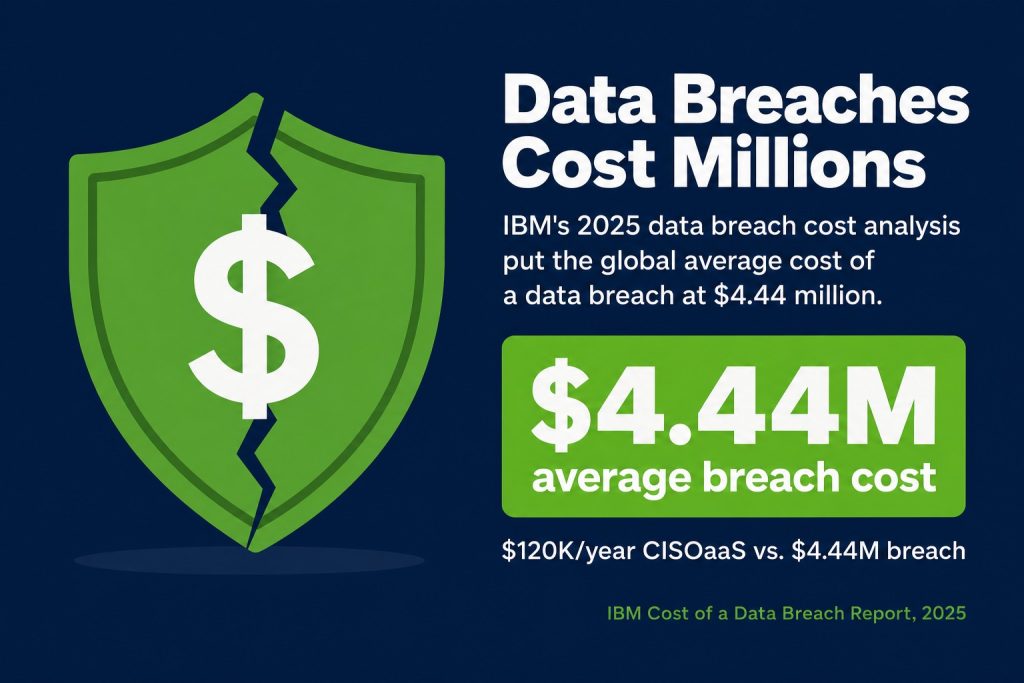
The cost of getting this wrong is real. IBM’s 2025 data breach cost analysis put the global average cost of a data breach at $4.44 million, down from $4.88 million the year prior. A $10,000/month CISOaaS engagement costs $120,000 per year. The math on prevention versus recovery doesn’t require a calculator.
How to Choose the Right CISOaaS Provider
Choosing a CISOaaS provider requires more scrutiny than most technology purchases because the relationship involves direct access to your most sensitive business information, your security gaps, and your executive leadership team.
Start with these questions before signing anything:
- Who will actually do the work? Ask for the name and background of your assigned advisor. “Firm credibility” means nothing if your day-to-day contact is a junior analyst reading from a script.
- What compliance frameworks do they specialize in? A provider with deep SOC 2 experience may have limited CMMC or HIPAA depth. Match their track record to your actual requirements.
- What’s included versus billed separately? Incident response, risk assessments, penetration testing coordination, and compliance audit support are sometimes bundled and sometimes extras. Know before you commit.
- How do they handle incidents? Ask about a real scenario. How do they communicate during a breach? What’s their escalation path? Who calls the lawyers?
- Can they provide references from similar organizations? Not logo slides. Actual conversations with clients in your industry and at your size.
The SEC’s cybersecurity disclosure rules now require board-level security oversight for publicly traded companies. That pressure is filtering down to private companies through customer contracts and supply chain requirements. A credible CISOaaS provider should be fluent in this regulatory environment, not learning about it on your time.
If you’re working through how to structure your broader security approach, our cybersecurity guidance for SMEs covers the foundational elements worth getting right before you bring in external leadership. And if compliance is what’s driving your search, our breakdown of ISO 27001 certification requirements and our guide to SOC 2 compliance will help you understand what a good CISOaaS provider should be building toward.

Frequently Asked Questions About CISO as a Service
Is CISOaaS the same as a virtual CISO?
In most cases, yes. CISO as a Service and virtual CISO describe the same fundamental model: outsourced, strategic security leadership delivered on a flexible engagement basis. The terminology varies by provider, and “CISOaaS” sometimes implies a more structured, firm-delivered service while “vCISO” can signal an individual practitioner. Always confirm what’s behind the label.
How is CISOaaS different from an MSSP?
A managed security services provider handles operational security: monitoring, threat detection, alert response. CISOaaS handles security leadership, governance, and strategy. An MSSP tells you when something is wrong. A CISOaaS provider helps you decide what to fix, why it matters to the business, and how to prove it to a board or auditor. Many organizations need both.
What compliance frameworks can CISOaaS support?
A capable CISOaaS provider should be able to support SOC 2, ISO 27001, HIPAA, PCI DSS, and CMMC, plus sector-specific frameworks relevant to your industry. The depth varies by provider, so match their specialization to your specific requirements before engaging.
How long does it take to see results from CISOaaS?
A basic risk assessment and gap analysis typically completes in the first 30 to 60 days. Compliance certification timelines depend on the framework: SOC 2 Type I can be achievable in three to six months for organizations with reasonable controls already in place. ISO 27001 typically takes nine to twelve months minimum. The provider should give you a realistic timeline at the outset, not a sales pitch.
The Practical Decision
CISO as a Service exists because the alternative, hiring a full-time Chief Information Security Officer, is out of reach for most organizations that genuinely need security leadership. The talent shortage is real. The salary is real. The 107-day average hiring timeline is real. CISOaaS closes that gap without forcing you to choose between security and solvency.
But it only works if you pick the right provider and the right model for where your business actually is. Start with an honest assessment of your compliance obligations and your biggest risk exposures. Then look for a CISOaaS partner whose track record matches those specific requirements, not just their marketing materials.
The security decisions you make now determine how you respond when something goes wrong. And something always eventually goes wrong. For a more complete picture of how to build real-world resilience as an SME, our risk management framework guide is a practical next step.
Build the security program. Don’t wait for the breach to make the decision for you.

