









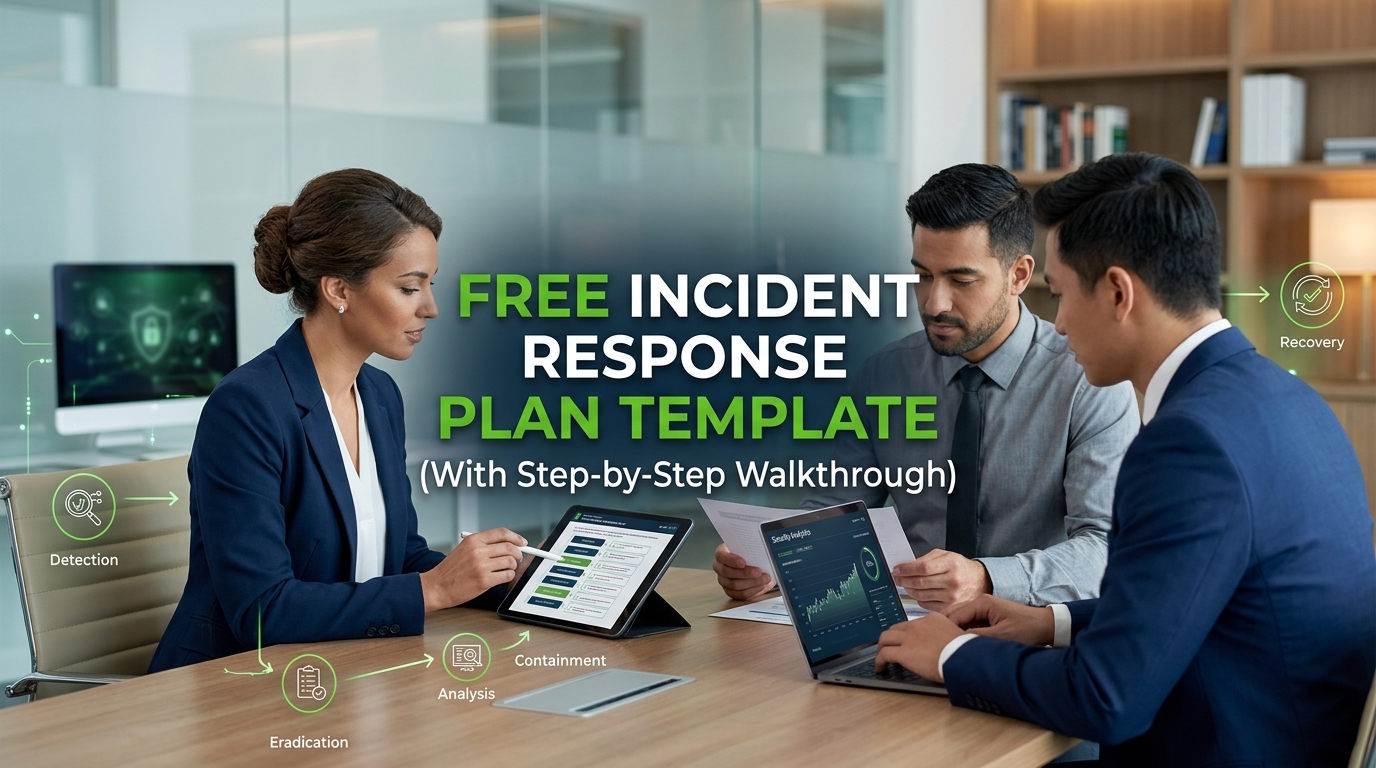
An incident response plan template is a pre-built, structured document that defines exactly how your organization detects, contains, and recovers from a cybersecurity incident. A complete template covers six core phases: preparation, detection and analysis, containment, eradication, recovery, and lessons learned. It assigns specific roles and responsibilities to named team members, classifies incidents by severity, and documents communication protocols for internal teams, regulators, and the public. NIST SP 800-61 Revision 3, finalized on April 3, 2025, provides the authoritative federal framework that most professional incident response plan templates are built upon, according to the National Institute of Standards and Technology.
Most businesses treat incident response like a fire extinguisher. They buy it, stick it on the wall, and never think about it again. That’s how a manageable security incident becomes a full-scale disaster. If you want a plan that actually works when things go wrong, this walkthrough will get you there.
What Is an Incident Response Plan Template?
An incident response plan template is a ready-to-customize framework that guides your security team through every stage of a cybersecurity incident, from the first alert to the final report. It removes the guesswork from a moment when guesswork is most dangerous.
A plain-English way to think about it: your incident response plan is the playbook your team runs when the alarm goes off. The template is the blank version of that playbook, structured so you fill in your organization’s specifics rather than building from scratch under pressure.
The template typically includes defined incident types, a severity classification matrix, escalation paths, contact lists, evidence-handling procedures, and post-incident review processes. A strong incident response plan template doesn’t just tell you what to do. It tells you who does it, when, and in what order.
Without one, teams improvise. And improvised incident response costs significantly more, takes longer, and leaves more damage behind.
Why Your Organization Needs an Incident Response Plan
The UK government’s Cyber Security Breaches Survey found that only 25% of UK businesses had a formal incident response plan in 2025/2026, according to the UK government’s official survey data. That means three in four organizations are winging it during some of the worst moments they’ll face.

That number should bother you. Not because of the regulatory optics, but because of what happens in the gap between “incident detected” and “incident resolved” when there’s no plan on the table.
IBM’s 2025 cost analysis found the global average cost of a data breach dropped 9% to $4.44 million, according to IBM’s X-Force report. The drop sounds encouraging until you see that the average breach lifecycle still ran 241 days, according to analysis of IBM’s 2025 breach data. Eight months from breach to resolution. For healthcare, the numbers are worse. Healthcare was the costliest sector for the 15th consecutive year, at $7.42 million per breach, according to IBM’s Middle East and Africa data breach findings.
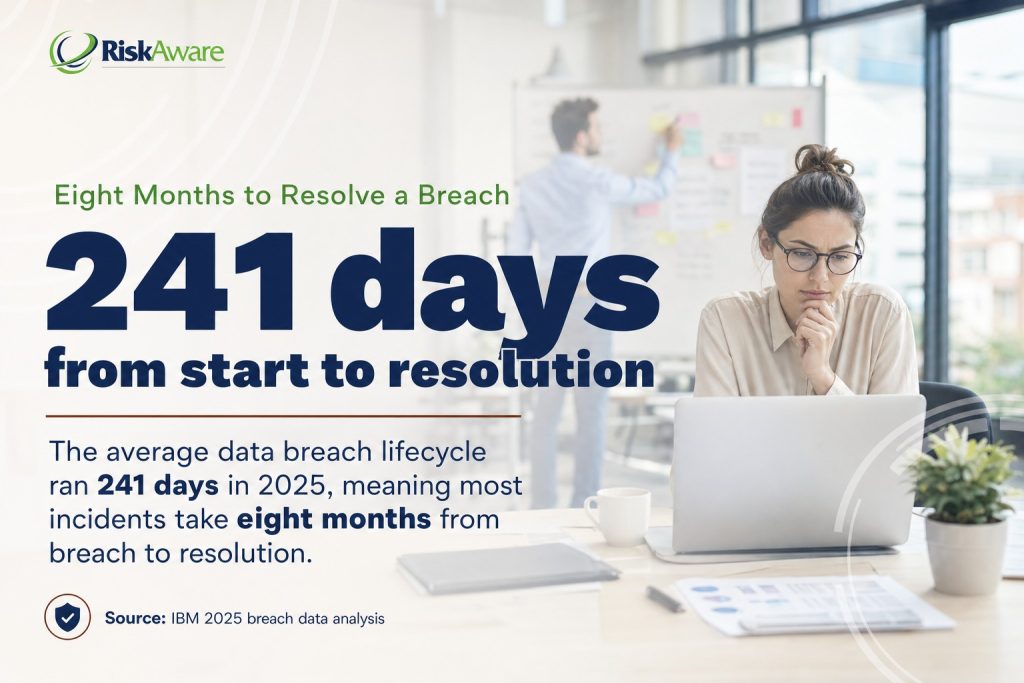
A well-tested incident response plan compresses that 241-day lifecycle. It shortens detection time, cuts containment delays, and reduces the financial exposure that multiplies with every day an incident runs uncontrolled.

There’s also a compliance dimension. The SEC’s May 2024 amendments to Regulation S-P explicitly require written incident response programs from broker-dealers and investment advisors, according to Dechert’s regulatory analysis. HIPAA has always required documented breach response procedures. PCI DSS mandates formal incident response capabilities for any organization handling card data. An incident response plan isn’t optional anymore. For a growing number of sectors, it’s legally required.
Key Components of an Incident Response Plan Template
A well-built incident response plan template contains eight core components, each serving a specific function in the response lifecycle. Miss one and you’ll feel it at the worst possible time.
The Eight Core Components
- Purpose and scope statement: What the plan covers, which systems and data it protects, and which teams it applies to.
- Roles and responsibilities matrix: Named individuals, their backups, and their specific duties during a security incident.
- Incident classification and severity matrix: A four-tier system (critical, high, medium, low) that determines response speed and escalation paths.
- Detection and analysis procedures: How your team identifies a potential cybersecurity incident, what tools they use, and how they confirm it’s real.
- Containment, eradication, and recovery steps: The operational playbook for each incident type, broken out by phase.
- Communication plan: Internal notification trees, external reporting obligations, and public-facing messaging guidance.
- Evidence and forensics handling: Chain-of-custody procedures to preserve data for investigation and potential legal proceedings.
- Post-incident review template: A structured lessons learned process that captures what happened, what worked, and what changes to make.
Each component connects to the next. The severity matrix, for example, feeds directly into the communication plan. A critical incident triggers a different notification sequence than a low-severity event. That linkage is what makes an incident response plan template function as a system rather than a collection of separate documents.
The Severity and Classification Matrix
Your incident classification system is the traffic signal that controls everything else. Get it wrong and your team wastes time treating a phishing simulation like a data breach, or worse, treating an active ransomware attack like a routine support ticket.
A practical four-tier matrix looks like this:
| Severity Level | Description | Initial Response Time |
|---|---|---|
| Critical | Active data breach, ransomware spread, or system-wide compromise | Immediate (within 15 minutes) |
| High | Confirmed malware infection, unauthorized access to sensitive data | Within 1 hour |
| Medium | Suspected phishing compromise, policy violation with exposure risk | Within 4 hours |
| Low | Isolated anomaly, failed login attempts without confirmed breach | Within 24 hours |
The 2026 Verizon Data Breach Investigations Report analyzed more than 22,000 confirmed data breaches across 145 countries, the largest dataset in the report’s history, according to Verizon’s official DBIR announcement. That volume tells you something important: incidents are not rare events. They’re a near-certainty. Your classification matrix needs to be fast and unambiguous because your team will use it under pressure.
The Incident Response Lifecycle: Phases and Steps
The NIST incident response lifecycle defines six sequential phases that every incident response plan template should be built around: preparation, detection and analysis, containment, eradication, recovery, and lessons learned.
NIST SP 800-61 Revision 3, finalized in April 2025, refined this lifecycle to place greater emphasis on pre-incident planning and post-incident integration. The SANS Incident Handler’s Handbook uses a similar phase structure, sometimes condensed to six steps, and the CIS Controls framework maps incident response to Controls 17 and 18. All three converge on the same operational logic: structured phases prevent chaos.
Phase 1: Preparation
Preparation is everything that happens before an incident occurs. This is where your incident response plan template lives, gets tested, and gets updated. It includes assembling your incident response team, documenting asset inventories, deploying detection tools like SIEM, IDS/IPS, and EDR platforms, and running tabletop exercises to stress-test your procedures.
Preparation is also where most organizations fail. They build the plan. They never run a drill. Then a real incident hits and the plan is a PDF no one has read since the auditor left.
Phase 2: Detection and Analysis
Detection and analysis is the phase where your team confirms that a security incident has occurred, not just a false alarm. This requires log monitoring, indicators of compromise analysis, and a clear threshold for escalation from “possible” to “confirmed” incident status.
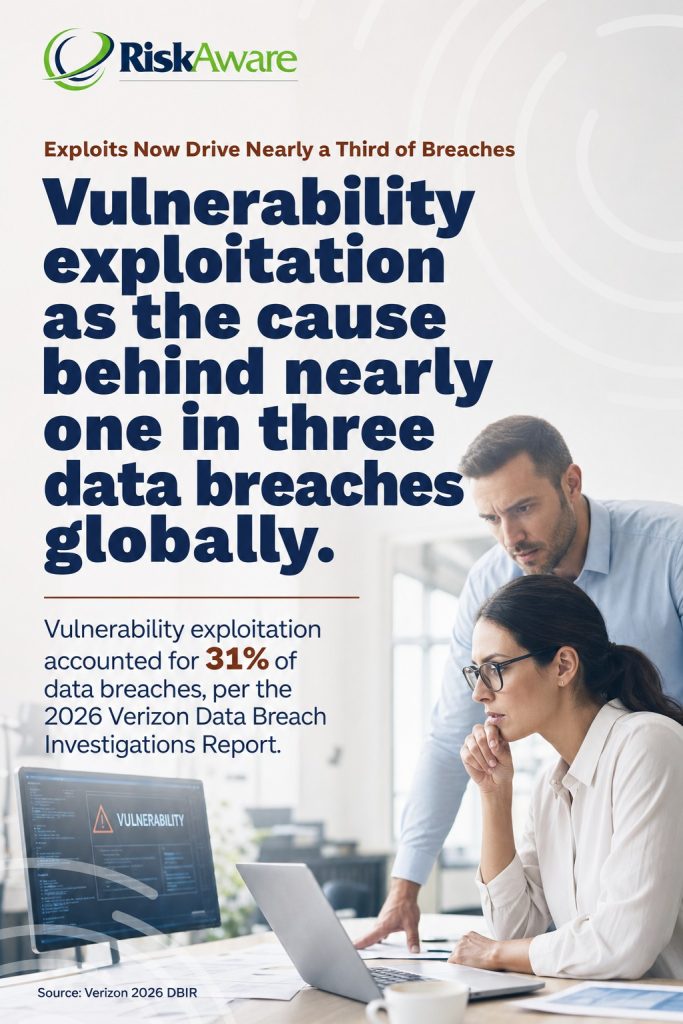
The 2026 DBIR found vulnerability exploitation accounted for 31% of data breaches, according to analysis of the Verizon 2026 DBIR findings. That means your detection tools need to flag unpatched systems and active exploit attempts, not just malware signatures. Detection and analysis tools you should have in place include SIEM platforms, EDR solutions, and network intrusion detection systems.
Phase 3: Containment
Containment stops the bleeding. Your incident response plan template should define both short-term containment (isolating affected systems immediately) and long-term containment (implementing interim controls while you investigate). The specific containment steps differ by incident type. Ransomware containment looks different from a DDoS response or an insider threat investigation.
Phase 4: Eradication
Eradication removes the root cause. That means deleting malware, closing the exploited vulnerability, resetting compromised credentials, and verifying clean system states before moving to recovery. Skipping proper eradication and jumping straight to recovery is how organizations end up with repeat incidents from the same attacker.
Phase 5: Recovery
Recovery restores normal operations. Your incident response plan template should specify recovery time objectives, define who authorizes the return-to-production decision, and document how to monitor restored systems for signs of reinfection. Recovery isn’t finished when the system comes back online. It’s finished when you’re confident the threat is gone.
Phase 6: Lessons Learned
Lessons learned is the phase most teams skip. That’s a mistake. A structured post-incident review, conducted within two weeks of resolution, captures root cause analysis, response timeline gaps, and specific changes to the incident response plan. Without lessons learned, you run the same playbook into the same wall next time.
How to Create an Incident Response Plan Step by Step
Building an incident response plan from scratch follows a logical sequence. Use this as your creation roadmap, then customize the details for your organization’s size, industry, and risk profile.
No two incident response plans look identical. A 15-person consultancy has different assets, different regulatory obligations, and a different incident response team structure than a 500-person financial services firm. The process below works for both.
Step 1: Define Scope and Objectives
Start by deciding what your incident response plan covers. Which systems? Which data types? Which locations and teams? Write this down explicitly. “Everything” is not a scope statement. Name the specific environments: cloud infrastructure, on-premises servers, employee endpoints, third-party SaaS tools.
Step 2: Assemble the Incident Response Team
Build your incident response team before you need it. Assign a primary and backup for each role. Document contact details, escalation order, and decision authority. Your team needs to know who calls the shots when it’s 2 a.m. and a server is sending data to an unknown IP address.
Step 3: Build the Incident Classification Matrix
Use the four-tier severity system (critical, high, medium, low) and map each tier to specific response times, notification requirements, and escalation paths. This matrix becomes the decision engine for every incident your team faces.
Step 4: Document Phase-by-Phase Procedures
Write specific, step-by-step procedures for each of the six NIST incident response phases. For each major threat scenario, including ransomware, phishing, DDoS attacks, data breaches, and insider threats, create a dedicated playbook that your team can follow without needing to improvise.
Step 5: Write the Communication Plan
Define who communicates what, to whom, and when. Your communication plan should cover internal notifications (executive team, IT, HR, legal), external notifications (regulators, affected customers, law enforcement), and media or public statements. Regulatory notification deadlines vary by framework. GDPR requires notification within 72 hours of breach discovery. Failing to document these timelines in advance means missing them under pressure.
Step 6: Validate and Approve the Plan
Get formal sign-off from senior leadership. An incident response plan without executive buy-in is a document that gets ignored the moment it inconveniences someone. Legal counsel should review the communication and evidence-handling sections before the plan goes live.
Incident Response Plan Template Examples and Frameworks
Four major frameworks provide the structural backbone for most professional incident response plan templates: NIST SP 800-61, the SANS Incident Handler’s Handbook, the CIS Controls framework, and CERT’s coordination methodology.
All four are worth knowing. But you only need to build to one primary standard. Pick the one that matches your regulatory environment and use the others to fill gaps.
NIST SP 800-61 Revision 3
NIST SP 800-61 Revision 3, finalized on April 3, 2025, is the definitive federal guidance for computer security incident handling, according to NIST’s official publication announcement. The revised guidance places greater weight on preparation and post-incident integration. If your organization operates in a regulated U.S. sector or works with federal agencies, this is your primary standard. An incident response plan template built to NIST SP 800-61 will satisfy most U.S. compliance requirements by default.
SANS Incident Handler’s Handbook
The SANS Incident Handler’s Handbook follows a similar six-phase structure to NIST and is widely used in practitioner training. It’s particularly useful for security teams that want operationally detailed guidance beyond the high-level NIST framework. SANS materials are freely available and updated regularly, making them a practical supplement to any incident response plan template.
CIS Controls
The CIS Controls framework maps incident response to Controls 17 and 18. For SMEs looking for a prioritized, practical starting point, CIS Controls provide a manageable entry into formal incident response without the full weight of NIST documentation. The CIS incident response template guidance is particularly well-suited for organizations still building foundational security practices.
CERT and ISACA
CERT’s coordination center provides incident response guidance oriented toward reporting and coordination with external bodies, useful when your incident involves law enforcement or cross-organizational impact. ISACA’s incident response frameworks connect well with broader IT governance programs like COBIT, making them a natural fit for organizations already using those governance structures.
Roles and Responsibilities in an Incident Response Plan
A clear roles and responsibilities matrix is what separates an incident response plan that functions under pressure from one that collapses into confusion. Every named role needs a primary, a backup, and a defined scope of authority.
Here are the core incident response team roles your plan should document:
- Incident Commander: Overall authority during the incident. Makes containment and escalation decisions. Typically the CISO or senior IT manager.
- Security Analyst: Conducts detection and analysis, runs forensic investigation, and executes technical containment steps.
- IT Operations Lead: Manages system isolation, coordinates eradication, and oversees the recovery process.
- Communication Officer: Handles internal messaging and coordinates external notifications to regulators, customers, and media.
- Legal Advisor: Reviews evidence-handling procedures, advises on regulatory notification obligations, and manages legal risk throughout the incident.
- HR Representative: Required for insider threat incidents. Manages the employee-related dimensions of investigation and potential disciplinary action.
- Executive Sponsor: Authorizes major decisions, resource allocation, and public statements. Needs to be reachable, not just nominally assigned.
For SMEs that don’t have a dedicated security team, some of these roles will overlap. A founder might serve as both incident commander and executive sponsor. That’s fine. What matters is that every function is assigned to a named person who knows they hold that responsibility before an incident happens.
Roles and responsibilities also extend to third parties. If you use a managed security service provider, document exactly what they own versus what your internal team owns. Ambiguity here costs time during an active incident, and time is the resource you have least of.
How to Test and Maintain Your Incident Response Plan
An incident response plan that has never been tested is a plan you cannot trust when you need it most. Testing is not optional. It’s the only way to find the gaps before an attacker does.
The 2026 DBIR’s finding that the median ransomware payment dropped to $139,875, according to SpyCloud’s analysis of Verizon’s 2026 DBIR, reflects organizations getting marginally better at response. But “marginally better” still means six-figure payments from incidents that a tested incident response plan can contain faster and cheaper.
Tabletop Exercises
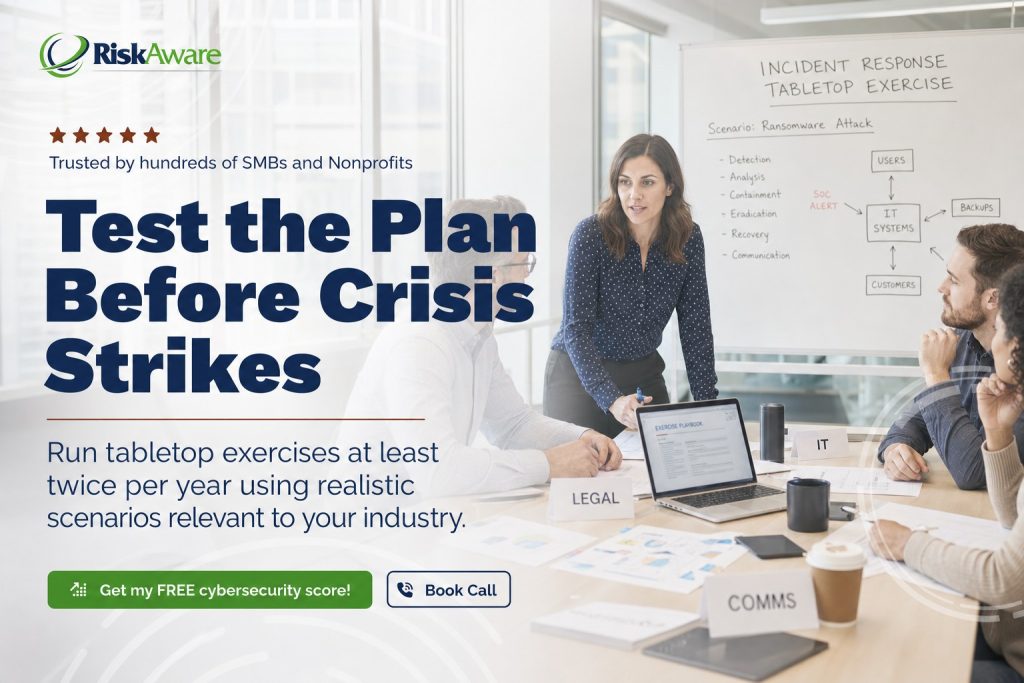
Tabletop exercises are structured discussion-based simulations where your incident response team walks through a hypothetical cybersecurity incident scenario in a conference room. No systems are touched. The goal is to expose gaps in your procedures, test team decision-making, and surface communication breakdowns before a real event forces them into the open.
Run tabletop exercises at least twice per year. Use realistic scenarios relevant to your industry: ransomware hitting your core systems on a Friday afternoon, a phishing attack that compromises a senior executive’s credentials, a DDoS attack timed to your busiest trading period. The more specific the scenario, the more useful the exercise.
Functional Testing and Full Simulations
Beyond tabletop exercises, functional testing activates specific parts of your incident response plan using real tools and systems in a controlled environment. Full-scale simulations run the entire incident response lifecycle from detection through lessons learned. These are more resource-intensive but reveal operational problems that discussion-based exercises miss entirely.
Plan Maintenance
Your incident response plan needs a scheduled review cycle. Update it after every significant incident, after every tabletop exercise that surfaces a gap, after any major change to your technology environment, and at minimum annually. A plan that hasn’t been touched in 18 months almost certainly no longer reflects how your organization actually operates.
For organizations looking to build out adjacent security capabilities, understanding your cybersecurity risk assessmentprocess is the logical next step alongside incident response planning. The two documents should directly inform each other.
Post-Incident Analysis and Continuous Improvement
Post-incident analysis, the lessons learned phase of the NIST incident response lifecycle, is where your incident response plan gets better over time. It’s also where most teams leave value on the table by rushing back to normal operations without documenting what went wrong.
A structured post-incident review should happen within two weeks of incident resolution, while the details are still clear. It should be a blameless process focused on systems and procedures, not individuals. The goal is root cause analysis, not finding someone to fault.
Document the full incident timeline. Map it against your incident response plan procedures and identify every point where the plan didn’t match reality. Those gaps become your next round of updates. This is how your incident response plan template evolves from a generic document into something built on actual operational experience.
Post-incident analysis also feeds your tabletop exercise library. The scenarios that most stress your team aren’t hypothetical. They’re the incidents you’ve already faced, abstracted into exercises so you can train against them without the cost of a live event.
Regulatory compliance requirements add another dimension. If your incident triggered a notification obligation under GDPR, HIPAA, or PCI DSS, your post-incident review should verify that notifications were made on time and document any compliance gaps for remediation. This documentation protects you if regulators follow up.
No incident response plan survives contact with a real incident unchanged. The organizations that improve fastest are the ones that treat every security incident as a paid lesson in how to do better next time. That starts with taking the lessons learned phase seriously.
If you want to build a full security program around your incident response plan, reviewing your organization’s cyber security policy framework ensures the two documents are aligned and mutually reinforcing.
Frequently Asked Questions
What should an incident response plan template include?
An incident response plan template should include a purpose and scope statement, a roles and responsibilities matrix, an incident classification and severity system, phase-by-phase response procedures aligned to NIST SP 800-61 or an equivalent framework, a communication plan for internal and external notifications, evidence-handling protocols, and a post-incident review template.
What are the six phases of incident response?
The six phases of the NIST incident response lifecycle are preparation, detection and analysis, containment, eradication, recovery, and lessons learned. Each phase has specific procedures, responsible parties, and exit criteria that move the response to the next stage.
How often should you update your incident response plan?
Update your incident response plan after every significant security incident, after tabletop exercises that reveal procedural gaps, after major changes to your technology infrastructure, and at minimum once per year. A plan that hasn’t been reviewed in 12 months is likely already out of date.
Who should be on an incident response team?
An incident response team typically includes an incident commander, security analyst, IT operations lead, communication officer, legal advisor, HR representative, and an executive sponsor. Smaller organizations may combine roles, but every function must be assigned to a named individual with a documented backup.
Is an incident response plan legally required?
For some organizations, yes. The SEC’s May 2024 amendments to Regulation S-P require written incident response programs from broker-dealers and investment advisors. HIPAA requires documented breach response procedures for covered entities. PCI DSS mandates incident response capabilities for organizations handling payment card data. Regulatory requirements vary by sector and jurisdiction.
What is the difference between NIST and SANS incident response frameworks?
NIST SP 800-61 is the federal standard, emphasizing policy-level guidance and a structured six-phase lifecycle. The SANS Incident Handler’s Handbook covers similar phases with more operational, practitioner-focused detail. Most professional incident response plan templates are built to NIST as the primary standard, with SANS materials used for technical depth and team training.
How do you test an incident response plan?
Test your incident response plan through tabletop exercises (discussion-based scenario walkthroughs), functional tests (activating specific plan components with real tools), and full-scale simulations (running the entire response lifecycle). Run tabletop exercises at least twice per year using scenarios relevant to your specific threat environment.
Your incident response plan is only as good as the last time someone actually used it. Build it properly, test it regularly, update it after every incident, and make sure every person on your incident response team knows their role before the alarm goes off. That’s not a high bar. But clearing it puts you ahead of the three in four organizations that haven’t.
Start today by downloading a NIST-aligned incident response plan template, assigning your incident response team roles, and scheduling your first tabletop exercise. For a broader view of how incident response fits into your overall security posture, the cyber security framework guidance on our site walks through the full picture.