









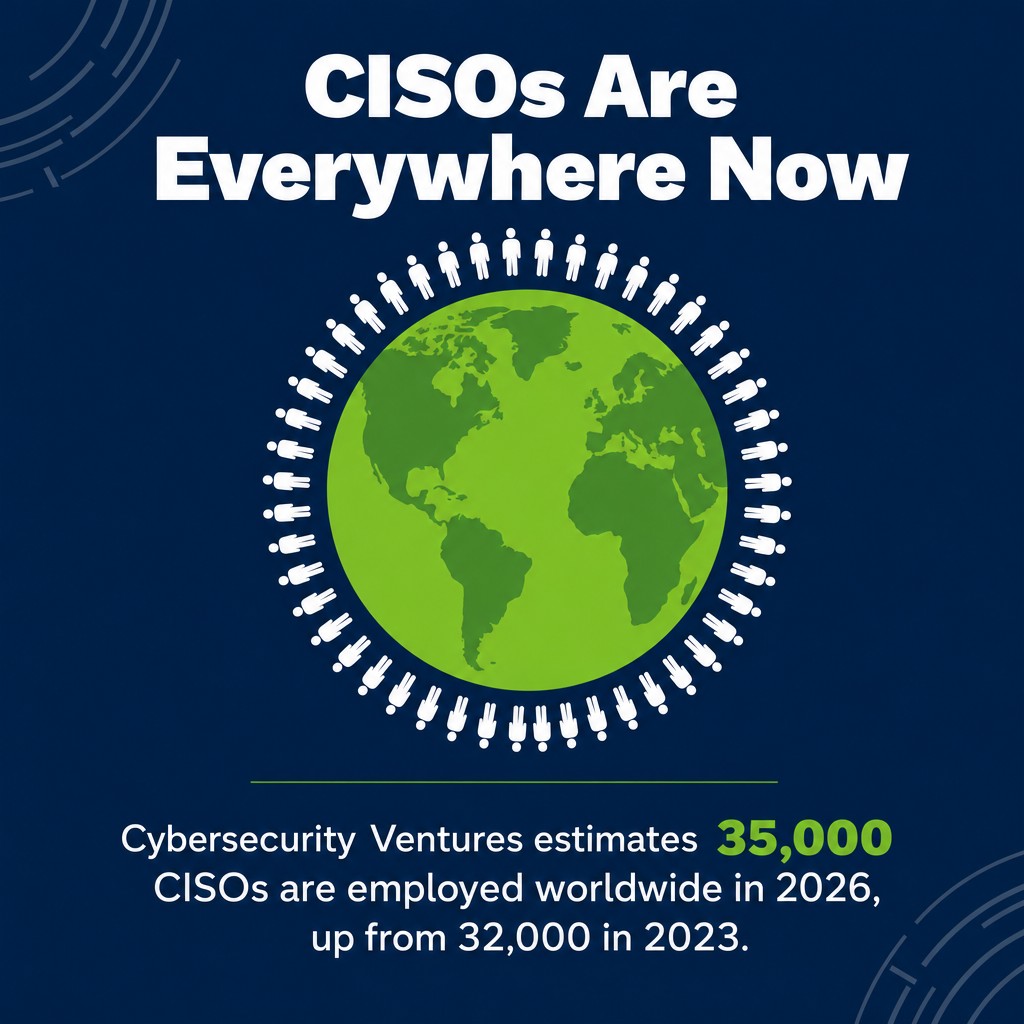
A Chief Information Security Officer (CISO) is the senior executive responsible for an organization’s entire information security program, from cybersecurity strategy and risk management to regulatory compliance and incident response. The CISO role sits in the C-suite alongside the CEO, CIO, and CTO, and owns the policies, teams, and processes that protect the business from data breaches, cyber threats, and operational disruption. Cybersecurity Ventures estimates 35,000 CISOs are employed worldwide in 2026, up from 32,000 in 2023, a number that signals just how central this role has become across every industry.
Most people have a vague sense that a CISO “handles security.” That undersells the job by a wide margin. A CISO is equal parts strategist, risk advisor, regulator, and communicator. If you’re a founder or business leader trying to figure out whether you need one, or what one actually does day to day, this is the clearest breakdown you’ll find.
What Is a CISO? Definition and the Origin of the Role
The Chief Information Security Officer is a C-suite executive who sets and enforces an organization’s information security strategy, governs cybersecurity risk, and ensures the business meets its compliance obligations. The CISO role is widely traced to 1995, when Citicorp appointed Steve Katz as the first Chief Information Security Officer, a direct response to a high-profile hacking incident. That origin story matters. The role was built around crisis, not theory.
For the first decade of its existence, the CISO was mostly a technical job buried in IT. Then data breach costs started climbing. Regulations multiplied. Boards woke up. The CISO moved up.
Today the chief information security officer sits at the intersection of technology, law, finance, and operations. That’s a wide brief. It’s also why the job is hard to fill, and hard to fake.
What Does a CISO Do? Core Responsibilities
The core responsibilities of a CISO span security operations, architecture, governance, risk, and compliance, and most CISOs now carry accountability for AI governance on top of all of that. More than 80% of CISOs oversee security operations, security engineering and architecture, governance, risk and compliance (GRC), application security, and identity and access management (IAM). That’s not a narrow technical remit. That’s most of the organization’s exposure surface.
The day-to-day picture looks like this:
- Cybersecurity strategy: Building and executing the multi-year plan to protect the organization’s data, systems, and people.
- Risk management: Identifying threats, quantifying their financial impact, and deciding where to invest protection.
- Security policies: Writing, enforcing, and updating the rules everyone in the business follows, from password standards to vendor contracts.
- Regulatory compliance: Keeping the organization aligned with frameworks like GDPR, NIST, PCI DSS, and FISMA.
- Incident response: Leading the business through a breach or attack, from containment to recovery and communication.
- Board and executive reporting: Translating technical risk into business language that non-technical leaders can act on.
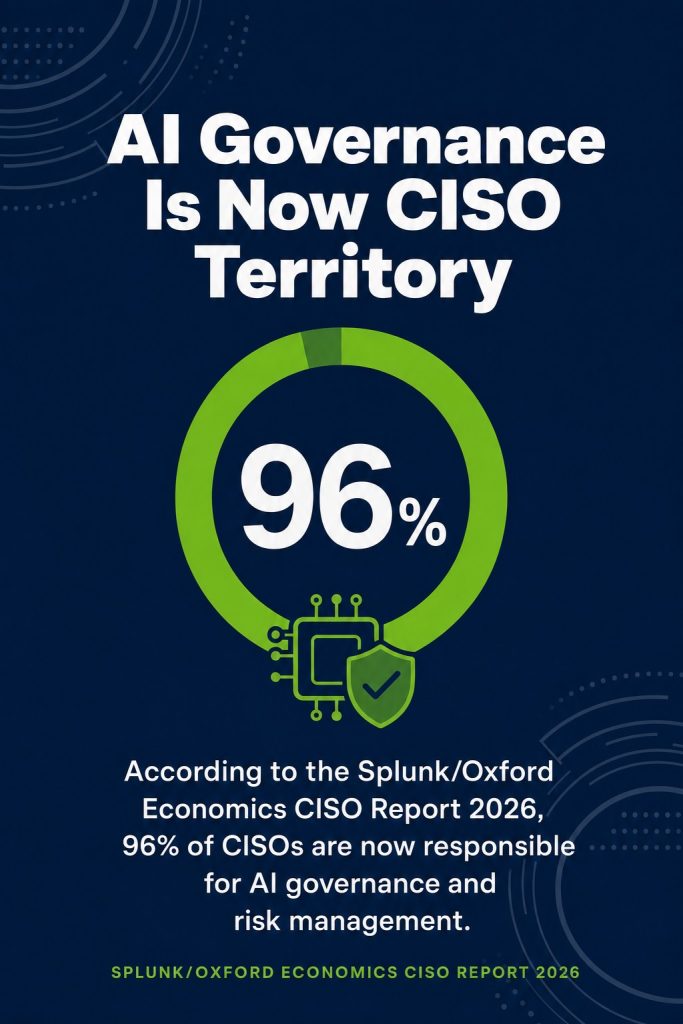
And then there’s the new frontier. According to the Splunk/Oxford Economics CISO Report 2026, 96% of CISOs are now responsible for AI governance and risk management. That’s a seismic shift in scope, and it happened fast.
The painful truth is that a CISO who only knows firewalls is already behind. The role demands business judgment as much as technical depth.
CISO vs. CIO vs. CTO vs. CSO: Key Differences
The Chief Information Security Officer focuses on protecting the organization’s information assets and managing cyber risk, while the Chief Information Officer (CIO) manages the overall IT strategy and infrastructure, and the Chief Technology Officer (CTO) drives technology product development and innovation. These three roles are often confused, and that confusion has real consequences for how organizations structure accountability.
The CIO asks: “How do we use technology to run the business better?” The CTO asks: “What technology should we build or adopt next?” The CISO asks: “How do we make sure none of that kills us if it goes wrong?”
| Role | Primary Focus | Typical Owner |
|---|---|---|
| CISO | Information security, cyber risk, compliance | Security teams, GRC, SOC |
| CIO | IT strategy, infrastructure, systems | IT operations, helpdesk, enterprise systems |
| CTO | Technology development, product, architecture | Engineering, R&D, product technology |
| CSO | Physical and corporate security (sometimes combined with CISO) | Physical security, executive protection |
The CISO and CIO relationship is the one that trips people up most often. When the CISO reports into the CIO, there’s a structural conflict of interest: IT wants to move fast and deploy new systems; security wants to slow down and check the risk. Keeping them separate fixes that tension.
A Chief Security Officer (CSO) may cover both physical and cyber security in some organizations. In others, the titles are used interchangeably with CISO. Don’t assume they mean the same thing at every company.
What Skills and Qualifications Does a CISO Need?
A CISO needs a blend of technical cybersecurity expertise, business acumen, risk management fluency, and the communication skills to brief a board of directors without losing the room. Neither a pure technologist nor a pure executive survives long in this role.
The 2025 ISC2 Cybersecurity Workforce Study found that 95% of cybersecurity teams reported at least one skills gap.That number reflects how hard it is to build a complete security function, and why the CISO’s ability to identify and close those gaps matters as much as their own technical knowledge.
Technical Skills
A CISO must have working knowledge across the core domains of information security. That includes network security, cloud security architecture, identity and access management, application security, and security operations. They don’t need to write the code. They do need to know when something is wrong.
Regulatory fluency is non-negotiable. A CISO who doesn’t understand GDPR, NIST frameworks, PCI DSS, or FISMA is a liability, not an asset.
Leadership and Business Skills
The technical side gets you in the room. Leadership keeps you there. Effective CISOs know how to manage teams under pressure, build cross-functional relationships, and translate security risk into financial terms the CEO and board of directors will actually respond to.
Budget management, vendor negotiation, and crisis communication are all part of the job. So is pushing back when the business wants to do something that creates unacceptable risk.
Professional Certifications
The two most widely recognized certifications for the CISO path are the CISSP (Certified Information Systems Security Professional) from ISC2 and the CISM (Certified Information Security Manager) from ISACA. CISSP proves broad technical depth across security domains. CISM is more management-focused and often considered the closer fit for the CISO role specifically.
Most CISOs hold at least one of these, and many hold both. A relevant bachelor’s degree in computer science, information systems, or a related field is standard. A master’s degree or MBA is increasingly common at the VP and C-suite level.
CISO Reporting Structure: Who Does a CISO Report To?
Where the CISO sits in the organizational hierarchy varies significantly by company size, with most CISOs still reporting into IT leadership rather than directly to the CEO. Per the IANS and Artico 2026 State of the CISO Benchmark Report, 64% of CISOs report into IT leadership.
But the picture changes sharply by company size. In smaller companies, 35% of CISOs report directly to the CEO; in organizations over 5,000 employees, that figure drops to just 2%. Larger enterprises tend to build more formal reporting layers. Smaller businesses often give the CISO direct access to the top.
The 2025 Heidrick and Struggles global CISO survey found that 42% of CISOs report directly to the CEO across their global sample, which suggests the trend toward more direct CEO access is real, even if it’s not yet the majority.
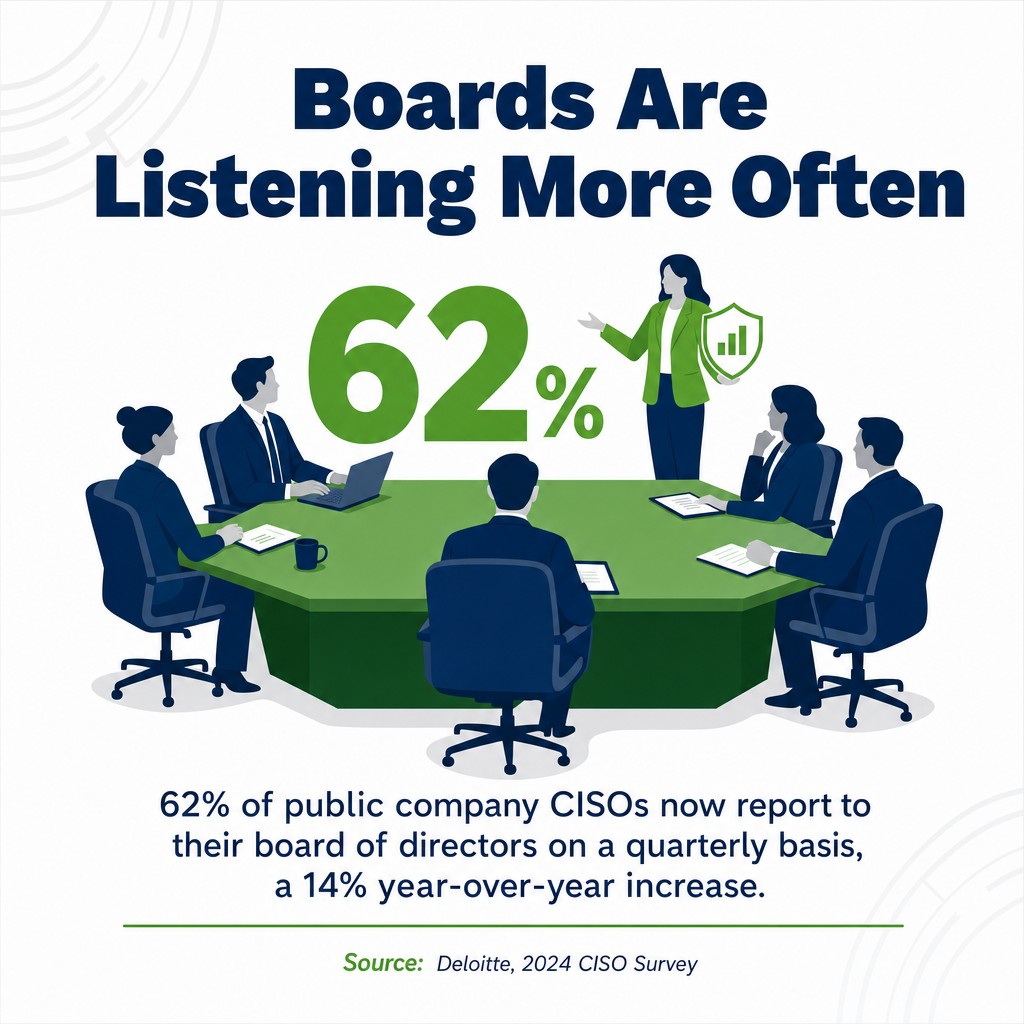
Board access is its own issue. 62% of public company CISOs now report to their board of directors on a quarterly basis, a 14% year-over-year increase. That shift matters. It means cybersecurity risk is increasingly treated as a board-level concern, not just an IT problem to be handled below the waterline.
If your CISO can’t get in front of your board, that’s a structural problem worth fixing.
How Much Does a CISO Earn? Salary and Compensation
CISO compensation in the United States reflects the seniority and accountability of the role, with total pay well into the six figures and growing year over year. Glassdoor data shows a typical total pay range for a chief information security officer in the U.S. of $227,268 to $372,982 annually, with an average of $288,744.
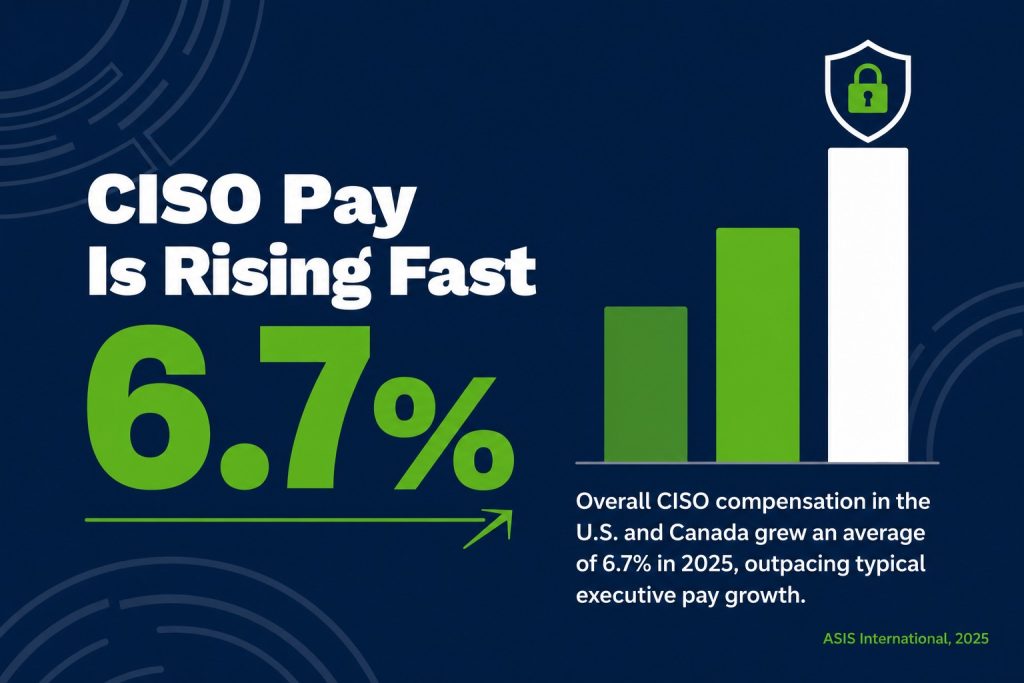
Overall CISO compensation in the U.S. and Canada grew an average of 6.7% in 2025, outpacing typical executive pay growth. The driver isn’t generosity. It’s scarcity. Qualified CISOs are hard to find, and the cost of getting the role wrong is enormous.
Total compensation packages at larger organizations frequently include base salary, performance bonuses, equity, and benefits. At Fortune 500 companies, total CISO compensation can push well above $500,000. At mid-market firms, the $250,000 to $350,000 range is more typical. Geography and industry sector also move the numbers significantly.
Why Does Your Organization Need a CISO?
Every organization that handles sensitive data, serves regulated industries, or operates at scale has cybersecurity risk that needs executive ownership, and a CISO is how you put a named executive in charge of that risk. Without one, security decisions get made by whoever is loudest or least busy, and that is not a strategy.
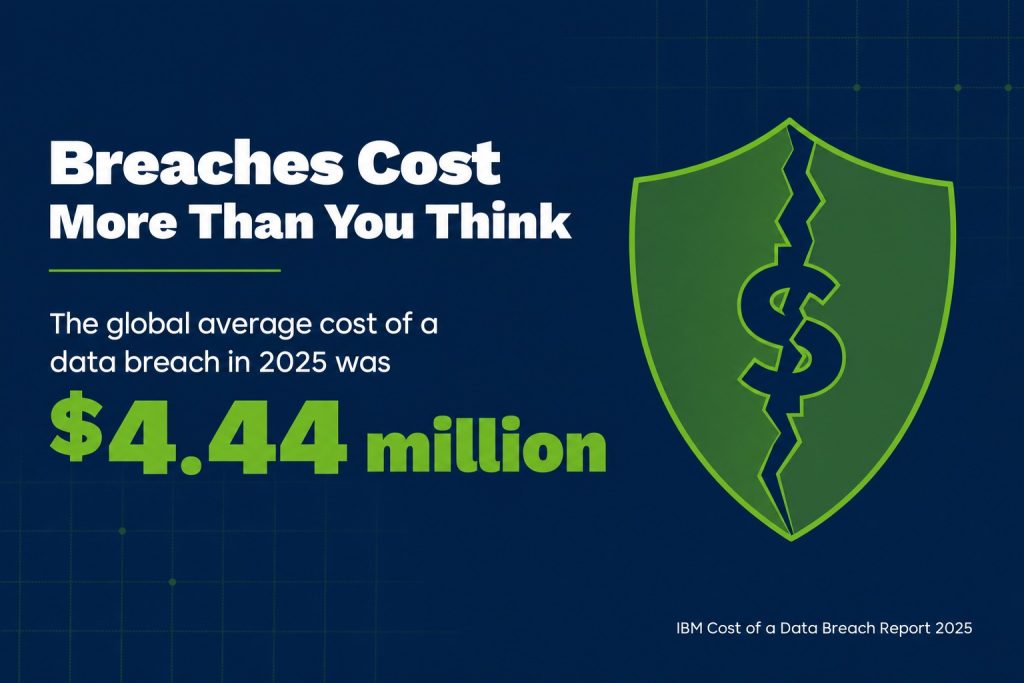
The cost of getting it wrong is not abstract. The global average cost of a data breach in 2025 was $4.44 million. That figure covers detection, containment, legal exposure, regulatory fines, customer notification, and reputational damage. Most mid-sized businesses would not survive a breach of that magnitude unscathed.
A CISO doesn’t just reduce the probability of a breach. They reduce the blast radius when something does go wrong, because the response plan exists before the crisis hits. That’s what incident response and business continuity planning actually look like in practice: decisions made in advance, not during the panic.
The Virtual CISO Option for Smaller Organizations
Not every organization can afford or justify a full-time chief information security officer. That’s where the virtual CISO, often called a vCISO or fractional CISO, comes in. A vCISO provides the same strategic security leadership on a part-time or contract basis, typically at a fraction of the cost of a full-time hire.
For SMEs, early-stage companies, and organizations that need to meet compliance requirements without the headcount, a vCISO can be the most practical path to executive-level information security coverage. The security strategy, risk management, and board reporting all happen. The engagement is just structured differently.
If you’re a business owner wondering whether your organization has the right level of cybersecurity oversight, our guide to the virtual CISO role breaks down exactly when a vCISO makes sense and what to look for.
How to Become a CISO: Career Path and Certifications
The typical path to the chief information security officer role runs through technical security roles, into management, and then into senior leadership, usually over 10 to 15 years of progressive experience. There is no single route, but the most common one looks like this:
- Start in a technical security role: Security analyst, penetration tester, network security engineer, or SOC analyst builds the foundational knowledge.
- Move into security management: Security manager or director roles develop the team leadership and budget skills the CISO role demands.
- Earn recognized certifications: CISSP and CISM are the standard benchmarks. Both require passing rigorous exams and demonstrating relevant work experience.
- Build business acumen: Many CISO candidates pursue an MBA or take on cross-functional projects that put them in front of finance, legal, and executive teams.
- Develop board-level communication skills: The ability to brief a board of directors on cyber risk, in plain language without jargon, separates CISO candidates from good security managers.
The role has also opened up to professionals coming from legal, compliance, and risk management backgrounds, particularly as regulatory complexity has grown. A CISO who understands GDPR, FISMA, and PCI DSS from a legal angle is genuinely valuable.
One honest note: the 2025 ISC2 Cybersecurity Workforce Study’s finding that 95% of cybersecurity teams have at least one skills gap cuts both ways. It means opportunities are real, and it means the bar for a fully rounded chief information security officer remains high. Aspiring CISOs who invest in both technical depth and business communication will stand out.

The CISO Role Is Now a Board-Level Priority
The chief information security officer has moved from a back-room IT function to a named seat at the executive table, and the organizations that recognized that shift earliest are the ones with the most mature cybersecurity postures today. Waiting until after a data breach to ask “who owns our security strategy?” is the most expensive question in business.
Whether you’re assessing your own organization’s security leadership, building a career path toward the CISO role, or trying to understand what your current CISO should actually be doing, the answer starts with clarity on scope and accountability. Security policies don’t enforce themselves. Risk management doesn’t happen by default. Someone has to own it.
If you’re a smaller business and a full-time chief information security officer isn’t realistic yet, that’s not a reason to leave the role vacant. It’s a reason to look seriously at fractional CISO services that give you executive-level cybersecurity leadership without the full-time hire. The exposure is real whether you have 20 employees or 2,000.
Secure your strategy. Name the owner. Don’t wait for the breach to make the case for you.

