









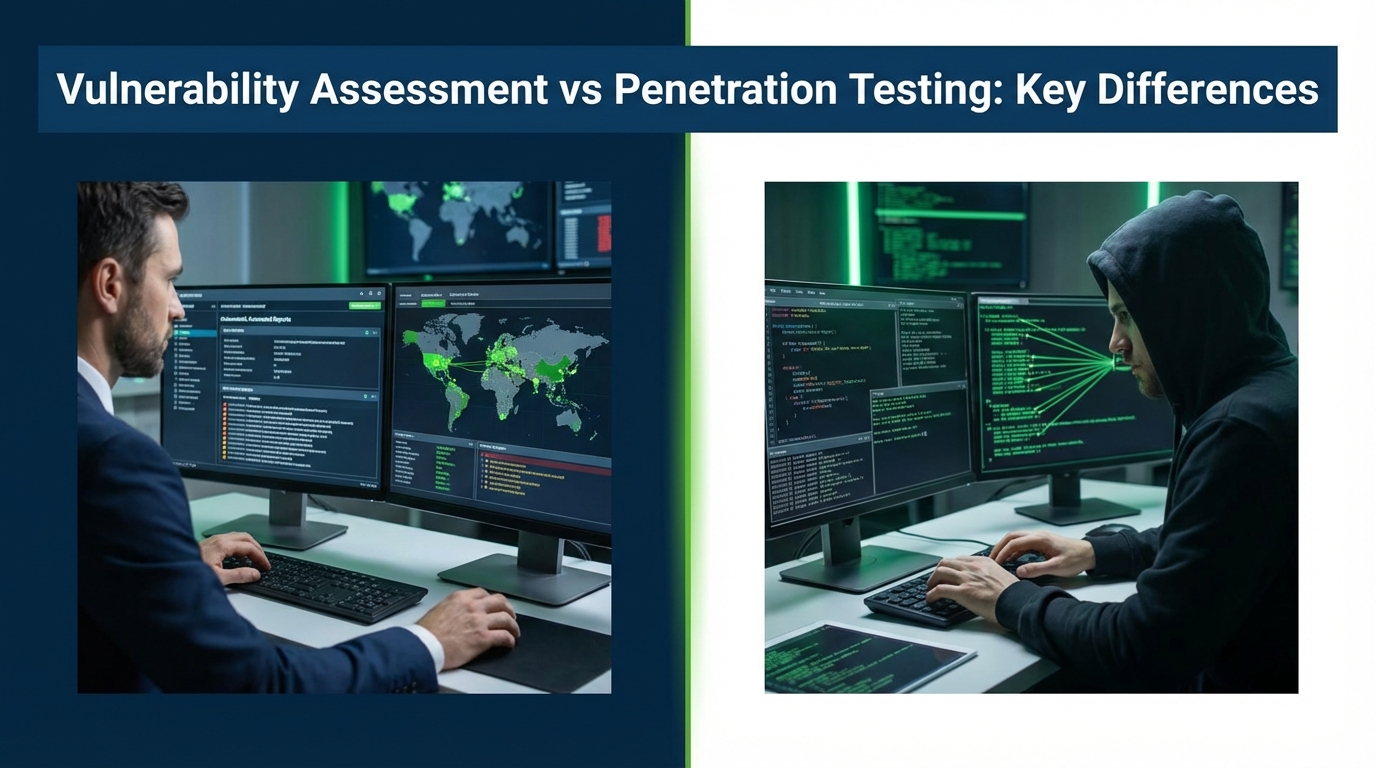
Your IT team just flagged 47 security weaknesses. Which ones actually matter?
That’s the exact problem vulnerability assessments solve. They catalogue known security weaknesses, often scored using frameworks like CVSS, to create a roadmap for patching based on known risks.

But here’s what most business leaders miss. Knowing a weakness exists doesn’t prove attackers can exploit it.
That’s where penetration testing comes in. Penetration testing aims to exploit flaws, assess impact, and test how security controls hold up under pressure by mimicking real-world threat actors.

One finds the cracks. The other proves someone can break through them.
I’ve watched SMEs waste thousands on the wrong approach. They run annual pentests but ignore monthly vulnerability scans. Or they scan everything but never validate what’s actually exploitable.
Both mistakes leave gaps attackers love.
This guide cuts through the confusion. You’ll learn exactly what each method does, when to use them, and how they work together to actually protect your business.
No jargon. No vendor pitches. Just straight answers for time-poor decision-makers.
What Is Vulnerability Assessment?
Think of vulnerability assessment as your security health check.
It’s automated scanning that identifies known weaknesses across your infrastructure. Software tools probe your systems, networks, and applications looking for vulnerabilities that attackers might find.
The process is non-intrusive. It doesn’t try to break in or exploit flaws. It simply identifies them.
Tools like Nessus and OpenVAS scan your environment against databases of known vulnerabilities. They check for missing patches, misconfigurations, weak passwords, and outdated software.
Each finding gets a severity rating. Critical issues demand immediate attention. Low-priority items can wait.

Most organizations run these monthly or quarterly. Some run them weekly for critical systems.
Why Automated Scanning Matters
Speed is the key advantage.
A vulnerability scanner can check thousands of systems in hours. Manual review would take weeks.
You get broad coverage across your entire infrastructure. Nothing gets missed because someone forgot to check it.
The output is a prioritized list. Your team knows exactly what to fix first based on risk scores and potential business impact.
Common Use Cases
Vulnerability assessments excel at routine security monitoring. They catch issues before attackers find them.
Compliance requirements often mandate regular scans. PCI DSS, HIPAA, and other regulations require documented vulnerability management programs.
After major changes, vulnerability scans validate your security posture. New servers, software updates, and network modifications all introduce potential weaknesses.
What Is Penetration Testing?
Now we’re talking about active exploitation.

Skilled security professionals act like ethical hackers. They try to break into your systems using the same techniques real attackers use.
The goal isn’t just finding vulnerabilities. It’s proving they’re actually exploitable and measuring the potential damage.
A penetration test might chain multiple vulnerabilities together. An attacker rarely needs one massive flaw. They exploit several small weaknesses in sequence to achieve their goal.
This human-driven approach uncovers issues automated tools miss. Business logic flaws, complex attack chains, and social engineering vulnerabilities require manual testing.
How Penetration Tests Work
Testing starts with reconnaissance. Penetration testers gather information about your systems, employees, and security measures.
Then comes active scanning and enumeration. They identify potential entry points and map your attack surface.
The exploitation phase is where things get real. Testers attempt to gain unauthorized access, escalate privileges, and move laterally through your network.
Post-exploitation activities demonstrate real-world impact. What data could an attacker access? Which systems could they compromise?
Finally, testers document everything in a detailed report with remediation guidance.
Manual Testing Advantages
Human expertise makes the difference.
Skilled penetration testers think like attackers. They adapt tactics based on what they discover. Automated tools follow scripts.
Complex vulnerabilities require context and creativity. SQL injection might exist, but can it actually be exploited given your specific configuration?
Penetration tests validate your security controls under pressure. Your firewall might be configured correctly, but does it actually block malicious traffic during an attack?
Key Differences Between Vulnerability Assessment and Penetration Testing
Understanding when to use each method starts with knowing how they differ.
Vulnerability assessments cast a wide net. They identify potential weaknesses across your entire infrastructure. Breadth is the priority.
Penetration testing zeros in on specific targets. Depth matters more than breadth. Testers prove what’s actually exploitable.
The approach fundamentally differs. Vulnerability scans are automated and scheduled. Penetration tests are manual and intensive.
Risk levels vary significantly. Vulnerability assessments are non-intrusive with minimal business disruption. Penetration tests actively exploit systems, which requires careful planning.
Frequency and Timing
Run vulnerability assessments frequently. Monthly scans catch new issues as they emerge.
Penetration tests happen less often. Annual testing is standard. Some organizations test quarterly for high-risk systems.
Major changes trigger penetration tests. New applications, infrastructure upgrades, and significant security control modifications all warrant validation.
Cost Considerations
Vulnerability scanning is more affordable. Automated tools require minimal ongoing investment once deployed.
Penetration testing costs more. You’re paying for skilled professional time. A thorough test requires days or weeks of expert effort.
Budget for both. They serve different purposes and complement each other perfectly.
Vulnerability Assessment vs Penetration Testing: Comparison Table
Here’s how these two security methods stack up side by side.
| Attribute | Vulnerability Assessment | Penetration Testing |
|---|---|---|
| Primary Goal | Identify and catalogue known weaknesses | Exploit vulnerabilities to prove real-world risk |
| Methodology | Automated scanning tools | Manual testing by skilled professionals |
| Scope | Broad coverage across entire infrastructure | Targeted testing of specific systems or applications |
| Intrusiveness | Non-intrusive, minimal business impact | Active exploitation, requires careful coordination |
| Frequency | Continuous, monthly, or quarterly | Annual or after major changes |
| Cost | Lower, primarily tool licensing | Higher, requires expert professional time |
| Output | Automated reports with vulnerability lists | Detailed narratives with exploitation proof |
| Skill Required | Lower, basic security knowledge sufficient | Higher, requires advanced security expertise |
Both methods identify security vulnerabilities. The difference is how deep they go.
Vulnerability assessments tell you what’s wrong. Penetration tests prove it matters.
When to Use Vulnerability Assessment
Regular vulnerability assessments belong in every security program.
Start here if you’re building your security foundation. Assessments give you visibility into your current security posture without major investment.
Compliance drives many assessment programs. Regulations require documented vulnerability management with regular scanning schedules.
Use assessments for continuous monitoring. Your infrastructure changes constantly. New vulnerabilities emerge daily. Regular scans keep you aware of your evolving risk profile.
Ideal Scenarios for Assessment
Large, complex environments benefit most from automated scanning. Manually tracking vulnerabilities across hundreds of systems is impossible.
Tight budgets favor vulnerability assessments. You get broad coverage at lower cost compared to penetration testing.
Rapid change environments need frequent scanning. Cloud infrastructure, DevOps pipelines, and agile development introduce new assets constantly.
Pre-penetration test scanning makes smart financial sense. Fix obvious issues first, then pay experts to find the subtle ones.
Making Assessments Actionable
Don’t just collect reports. Act on findings within defined timeframes.
Prioritize based on risk scores and business context. A critical vulnerability on a public-facing server demands immediate attention. The same issue on an isolated development box can wait.
Track remediation progress. Vulnerabilities don’t disappear because you found them. Verify patches and fixes actually close the gaps.
When to Use Penetration Testing
Penetration testing validates your security controls actually work.
Schedule tests before launching new applications or systems. You need confidence that security measures will hold up against real attacks.
Compliance often requires penetration testing. PCI DSS mandates annual tests plus testing after significant changes. Other frameworks have similar requirements.
High-value targets warrant deeper testing. Systems handling sensitive data, financial transactions, or critical business functions deserve penetration testing attention.
Strategic Testing Timing
Test after major security improvements. You invested in new controls. Validate they actually improve your security posture.
Annual testing establishes your security baseline. Year-over-year comparisons show whether you’re improving or regressing.
Post-incident testing prevents recurrence. If you suffered a breach, penetration testing identifies remaining gaps attackers might exploit.
Maximizing Test Value
Define clear objectives before testing begins. What systems matter most? What scenarios keep you up at night?
Choose the right test type. Black box testing simulates external attackers. White box testing with full knowledge finds more issues.
Plan for remediation time after testing. The report is worthless if you don’t fix what testers found.
How Vulnerability Assessments and Penetration Tests Work Together
Smart organizations don’t choose between these methods. They use both strategically.
Mature organizations combine both approaches as part of a layered security strategy.

Start with regular vulnerability assessments. They identify and track known weaknesses across your infrastructure.
Fix critical and high-severity findings immediately. Patch missing updates, correct misconfigurations, and address obvious security gaps.
Then bring in penetration testers. They validate your remediation efforts and find complex issues automated tools miss.
The Continuous Improvement Cycle
This creates a powerful security feedback loop.
Monthly vulnerability scans maintain baseline awareness. You know what weaknesses exist at any given time.
Quarterly or annual penetration tests validate your security controls. They prove whether identified vulnerabilities are actually exploitable.
Findings from both feed into your security roadmap. Vulnerability assessments show what to patch. Penetration tests show what to redesign.
Resource Optimization
This combined approach maximizes your security budget.
You’re not paying penetration testers to find missing patches. Vulnerability scanners handle that efficiently.
Penetration testing focuses on complex scenarios automated tools can’t evaluate. You get maximum value from expert time.
Together, they provide comprehensive security coverage without redundant spending.
Reporting Differences
The reports from each method look and feel completely different.
Vulnerability assessment reports are structured and standardized. They list every identified weakness with severity ratings, affected systems, and remediation guidance.
Automated tools generate these reports. The format is consistent and easy to track over time.
Penetration test reports tell a story. They explain the attack path, show how vulnerabilities were chained together, and demonstrate real business impact.
Human experts write these reports. They include screenshots, proof-of-concept exploits, and detailed technical narratives.
Using Reports Effectively
Vulnerability assessment reports drive your patching schedule. Prioritize by severity and exposure.
Track trends over time. Is your vulnerability count increasing or decreasing? Are you keeping up with patching?
Penetration test reports require executive attention. They prove actual risk and justify security investments.
Share sanitized versions with your board. They need to understand real-world attack scenarios, not just vulnerability counts.
Action-Oriented Documentation
Both report types should drive specific actions.
Vulnerability reports need clear ownership. Assign findings to specific teams with due dates.
Penetration test reports require remediation plans. Document how you’ll address each finding and when.
Retest critical findings. Verify your fixes actually closed the security gaps identified.
Common Questions About Vulnerability Assessment and Penetration Testing
What is the difference between vulnerability assessment and penetration testing?
Vulnerability assessments identify known security weaknesses through automated scanning. Penetration testing actively exploits those vulnerabilities to validate real-world exploitability and business impact.
Are VAPT and penetration testing the same?
No. VAPT combines both vulnerability assessment and penetration testing in one program. Penetration testing alone focuses only on exploiting weaknesses to validate attack scenarios.
How often should I run each type of test?
Run vulnerability assessments monthly or quarterly for continuous monitoring. Schedule penetration tests annually or after significant infrastructure changes.

Your Next Steps
Start with what you can implement this week.
If you’re not scanning regularly, that’s step one. Deploy a vulnerability assessment program to establish your security baseline.
Already scanning? Review your last three reports. What critical findings remain unfixed? Prioritize remediation before your next scan.
Ready for penetration testing? Define your most critical systems. Start there rather than testing everything at once.
The biggest mistake is doing nothing. Both vulnerability assessments and penetration testing require ongoing commitment, not one-time efforts.
Your security posture improves through consistent action. Regular scanning finds new issues. Periodic testing validates your defenses actually work.
Don’t wait for a breach to prove your security gaps are real. Start assessing your security posture now with the methods that fit your budget and risk profile.
Which approach will you implement first?

