








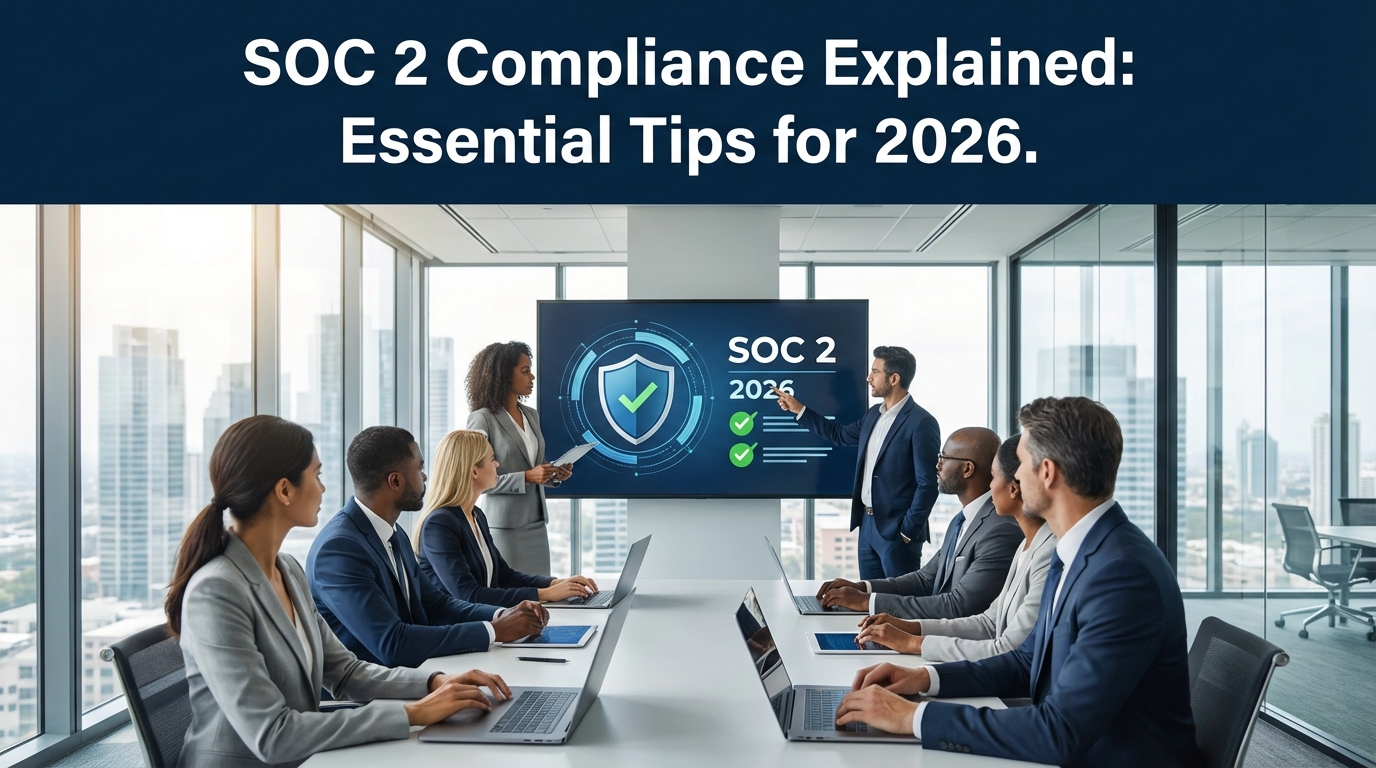
SOC 2 compliance isn’t a checkbox. It’s a framework that proves you can protect customer data.
SOC 2 is a set of standards devised by the American Institute of Certified Public Accountants (AICPA) to evaluate a service organization’s controls relevant to five Trust Services Criteria: security, availability, processing integrity, confidentiality, and privacy. If you’re running a SaaS company or handling client data in the cloud, this matters more than most compliance frameworks.

Here’s what makes SOC 2 different. It’s not prescriptive. The AICPA doesn’t hand you a checklist and say “do these 47 things.” Instead, they give you criteria and ask you to prove your controls work.
That flexibility is both a strength and a trap. You get to design controls that fit your actual business. But you also need to know what you’re doing.
This guide walks you through what SOC 2 actually requires. You’ll understand the Trust Services Criteria, the difference between Type 1 and Type 2 audits, and how to build controls that pass scrutiny. More importantly, you’ll know whether your organization needs SOC 2 and what it takes to get there.
No jargon. No false promises. Just the practical information you need to make smart decisions about SOC 2 compliance.
What SOC 2 Actually Means for Your Business
SOC 2 stands for Service Organization Control 2. The “2” matters because it distinguishes this framework from SOC 1, which focuses on financial reporting controls.
SOC 2 applies primarily to technology and SaaS providers that handle client data, with enterprise customers using SOC 2 reports to assess vendors. Your prospects want proof you won’t lose their data. SOC 2 provides that proof.
The framework emerged from a simple reality. Cloud computing changed everything about data security. Companies no longer control their own infrastructure. They trust third parties with sensitive information.
That trust requires verification.
SOC 2 is voluntary but increasingly essential for SaaS companies storing customer data in the cloud, as it demonstrates effective data processing and protection controls. Your competitors probably have it. Your enterprise prospects definitely require it.

Who Needs SOC 2 Compliance
Service organizations that store, process, or transmit customer data need SOC 2. That includes most SaaS companies, cloud service providers, data centers, and managed service providers.
If you answer yes to these questions, you probably need SOC 2:
- Do enterprise customers ask for your SOC 2 report during procurement?
- Does your service access or store sensitive client information?
- Are you losing deals because you can’t demonstrate security controls?
- Do contracts require third-party security audits?

Small startups often delay SOC 2 until they pursue enterprise customers. That’s a mistake. Building controls from day one is easier than retrofitting them later.
What SOC 2 Doesn’t Cover
SOC 2 isn’t a security strategy. It’s an audit framework that validates your existing controls.
The report won’t tell you how to architect your infrastructure. It won’t choose your security tools. It won’t write your incident response plan.
Those decisions remain yours. SOC 2 simply requires you to document them, implement them consistently, and prove they work.
The Five Trust Services Criteria Explained
Understanding SOC 2 means understanding the Trust Services Criteria. These five categories define what the auditor evaluates.
Every SOC 2 audit includes Security. The other four are optional based on your service and customer requirements.
Security: The Foundation of Every SOC 2 Audit
Security is mandatory for all SOC 2 audits. This criterion addresses how you protect systems and data from unauthorized access.
Key security controls include:
- Access management and authentication systems
- Network security and firewall configurations
- Encryption for data at rest and in transit
- Vulnerability management and patch processes
- Security monitoring and incident response capabilities
Security forms the baseline. Without it, nothing else matters. Your customers won’t trust you with their data if you can’t demonstrate basic security hygiene. Learn more about implementing robust information security strategies and best practices that support SOC 2 requirements.
Availability: Keeping Systems Running
Availability addresses your system’s operational performance. Can customers access your service when they need it?
This criterion evaluates:
- System uptime and performance monitoring
- Disaster recovery and business continuity plans
- Backup systems and redundancy measures
- Capacity planning and resource management
If you promise 99.9% uptime in your SLA, availability controls prove you can deliver it.
Processing Integrity: Accurate and Complete Data
Processing integrity ensures your system processes data correctly. Transactions complete as intended. Data doesn’t get corrupted or lost.
Controls focus on:
- Data validation and error handling
- Transaction completeness and accuracy
- Quality assurance processes
- System monitoring for processing errors
Financial services and healthcare companies often require this criterion. Data accuracy isn’t optional when money or medical records are involved.
Confidentiality: Protecting Sensitive Information
Confidentiality addresses information designated as confidential. This goes beyond general security to cover specific data protection requirements.
Key controls include:
- Data classification systems
- Non-disclosure agreements
- Confidential data handling procedures
- Secure data disposal methods
Don’t confuse confidentiality with privacy. Confidentiality protects any data marked as confidential. Privacy specifically addresses personal information.
Privacy: Managing Personal Information
Privacy aligns with privacy regulations like GDPR and CCPA. It addresses how you collect, use, retain, and dispose of personal information.
Privacy controls cover:
- Privacy notice and consent mechanisms
- Data subject access rights
- Data retention and deletion policies
- Third-party data sharing agreements
If you process personal data for EU or California residents, privacy becomes essential. Understanding data privacy compliance requirements helps you build controls that satisfy both SOC 2 and regulatory obligations.
SOC 2 Type 1 vs Type 2: Understanding the Difference
Two types of SOC 2 reports exist. They measure different things and serve different purposes.
SOC 2 Type 1 reports evaluate the design of controls at a single point in time, serving as a snapshot without testing operational performance. Type 2 tests whether those controls actually work over time.

Type 1: Design Effectiveness
Type 1 audits answer one question: Are your controls designed properly?
The auditor reviews your policies, procedures, and control descriptions. They verify controls exist and make sense on paper. But they don’t test whether you follow them consistently.
Type 1 serves as a stepping stone. It proves you’ve thought through your security posture. Many organizations pursue Type 1 first, then move to Type 2 later.
The audit takes less time and costs less money. But it carries less weight with enterprise customers.
Type 2: Operating Effectiveness
Type 2 is preferred by enterprise buyers as it proves controls work consistently under real-world conditions. The auditor tests your controls over an audit period, typically 3-12 months.
They examine evidence that proves consistent implementation:
- Access logs showing authentication controls work
- Firewall configuration reviews demonstrating network security
- Backup logs proving disaster recovery capabilities
- Security training records showing employee awareness
- Incident response documentation revealing how you handle breaches
Type 2 requires operational maturity. You can’t fake it. The evidence either exists or it doesn’t.
Most enterprise customers require Type 2. They want proof your controls function in practice, not just theory.
The SOC 2 Audit Process From Start to Finish
SOC 2 audits follow a structured process. Understanding each phase helps you prepare effectively.
Phase 1: Readiness Assessment
Before engaging an auditor, assess your current state. Many organizations hire consultants for readiness assessments.
The assessment identifies gaps between your current controls and SOC 2 requirements. You’ll receive a remediation plan outlining necessary changes.
This phase prevents surprises during the actual audit. Better to find problems internally than have an auditor document them officially.
Phase 2: Scope Definition
Define what systems and processes the audit will cover. Scope directly impacts cost and complexity.
Consider these scoping decisions:
- Which Trust Services Criteria to include
- Which systems and applications to evaluate
- Which organizational units to cover
- What data flows to examine
Narrow scope reduces costs but may not satisfy all customer requirements. Work with your sales team to understand what prospects need.
Phase 3: Control Implementation
Organizations must document controls, design them to meet the criteria, and provide evidence such as logs, access reviews, and incident records for auditor evaluation. This phase takes the longest.
Implementation includes:
- Writing security policies and procedures
- Configuring technical controls
- Training employees on security practices
- Establishing monitoring and logging systems
- Creating documentation for all processes
For Type 2, you’ll need 3-12 months of evidence demonstrating consistent control operation. Start collecting evidence early. Explore cybersecurity audit best practices to prepare your organization for the evaluation process.
Phase 4: The Audit Examination
The auditor performs fieldwork once controls are operational. They’ll request evidence, interview personnel, and test control effectiveness.
Expect requests for:
- System configuration screenshots
- Access control matrices
- Change management logs
- Vendor management documentation
- Incident response records
Respond promptly to auditor requests. Delays extend the audit timeline and increase costs.
Phase 5: Report Issuance
The auditor issues your SOC 2 report after completing fieldwork. The report includes:
- Management’s assertion about their control environment
- Auditor’s opinion on control design and effectiveness
- Detailed description of controls tested
- Test results and any exceptions noted
Reports are confidential. You share them with customers under NDA as part of vendor assessments.
Building SOC 2 Controls That Actually Work
Controls are the heart of SOC 2 compliance. They’re the policies, procedures, and technical measures that protect your systems.
Good controls balance security with operational efficiency. They protect data without grinding work to a halt.
Administrative Controls
Administrative controls are the policies and procedures that guide security decisions. They define how your organization approaches security.
Essential administrative controls include:
- Security policies defining acceptable use and requirements
- Risk assessment processes identifying threats and vulnerabilities
- Security awareness training for all employees
- Vendor management procedures for third-party risk
- Incident response plans detailing breach procedures
Documentation matters. Auditors can’t evaluate controls that exist only in someone’s head.
Technical Controls
Technical controls are the systems and tools that enforce security. They provide the technical foundation for your security posture.
Critical technical controls include:
- Multi-factor authentication for system access
- Encryption for sensitive data at rest and in transit
- Firewall rules restricting network traffic
- Security information and event management (SIEM) systems
- Automated backup and recovery systems
Technical controls generate evidence. Logs prove your controls function consistently. Understanding cloud security best practices helps you implement effective technical controls in cloud environments.
Physical Controls
Physical controls protect your infrastructure from unauthorized physical access. Even cloud-based companies need physical security for offices and data centers.
Physical controls cover:
- Data center access restrictions and monitoring
- Badge access systems for office facilities
- Visitor management and escort procedures
- Environmental controls for equipment protection
If you use AWS, Azure, or Google Cloud, your infrastructure provider’s SOC 2 report covers their physical controls. You still need controls for your office.
Common SOC 2 Audit Findings and How to Avoid Them
Most organizations receive findings during their first SOC 2 audit. Understanding common issues helps you prevent them.
Inadequate Access Controls
Access control findings are the most common. Organizations fail to restrict access appropriately or document who has access to what.
Prevent this by:
- Implementing role-based access control
- Conducting quarterly access reviews
- Documenting access approval processes
- Removing access promptly when employees leave
The principle of least privilege matters. Users should have the minimum access required for their role.
Missing or Incomplete Documentation
Controls without documentation don’t exist in an audit. Auditors need written evidence of policies, procedures, and control descriptions.
Document everything:
- Security policies and standards
- System configuration guides
- Change management procedures
- Vendor due diligence reviews
Templates help maintain consistency. But customize them for your actual practices. Auditors spot generic policies immediately.
Inconsistent Control Operation
Type 2 audits fail when controls work sometimes but not consistently. You might have great policies but poor execution.
Common consistency problems:
- Quarterly access reviews completed late or skipped
- Security training not completed by all employees
- Change management process bypassed for urgent fixes
- Vulnerability scans run sporadically instead of monthly
Organizations report 30-50% faster incident response times after achieving SOC 2 compliance due to refined processes in access management and disaster recovery. That benefit only comes from consistent operation.

Inadequate Vendor Management
Third-party risk is critical. If your vendors get breached, your data gets compromised.
Auditors expect to see:
- Vendor risk assessments before onboarding
- Security requirements in vendor contracts
- Annual reviews of vendor security practices
- SOC 2 reports from critical vendors
Don’t skip vendor management. It protects your organization and satisfies auditor requirements. Learn more about protecting customer data throughout your vendor ecosystem.
SOC 2 Cost and Timeline Realities
SOC 2 compliance requires significant investment. Understanding costs helps you budget appropriately.
Audit Costs
Audit fees vary based on scope, company size, and auditor choice. Expect these ranges:
| Audit Type | Small Company | Mid-Size Company | Enterprise |
|---|---|---|---|
| Type 1 | $10,000-$20,000 | $20,000-$40,000 | $40,000+ |
| Type 2 | $25,000-$50,000 | $50,000-$100,000 | $100,000+ |
These are audit-only costs. They don’t include preparation, tooling, or consulting.
Implementation Costs
Building controls costs more than the audit itself. Budget for:
- Security tools and infrastructure upgrades
- Consulting fees for readiness assessments
- Employee time dedicated to compliance
- Documentation and policy development
- Third-party services for gap remediation
Total first-year costs often reach $100,000-$300,000 for small to mid-size companies.
Timeline Expectations
Don’t expect quick compliance. Type 2 requires minimum 3 months of evidence collection. Full implementation takes longer.
Realistic timeline:
- Readiness assessment: 2-4 weeks
- Gap remediation: 2-6 months
- Evidence collection: 3-12 months
- Audit fieldwork: 4-8 weeks
- Report issuance: 2-4 weeks
Total timeline from start to report: 9-18 months for Type 2.
Comparing SOC 2 to Other Compliance Frameworks
SOC 2 isn’t the only security framework. Understanding how it compares helps you choose the right approach.
SOC 1 vs SOC 2 vs SOC 3
The SOC family includes three report types serving different purposes.
| Report Type | Focus Area | Audience | Distribution |
|---|---|---|---|
| SOC 1 | Financial reporting controls | Auditors and financial stakeholders | Restricted |
| SOC 2 | Security and trust services | Management and stakeholders under NDA | Restricted |
| SOC 3 | Security (general summary) | General public | Public |
SOC 1 matters if your service affects customer financial statements. Payroll processors and payment gateways typically need SOC 1.
SOC 3 provides a public trust seal but lacks the detail enterprise customers require. Most companies pursue SOC 2 instead.
ISO 27001 vs SOC 2
ISO 27001 is an international information security standard. It’s certification-based while SOC 2 is attestation-based.
Key differences:
- ISO 27001 certifies your entire information security management system
- SOC 2 attests to specific controls relevant to Trust Services Criteria
- ISO 27001 works better for global companies with European customers
- SOC 2 is preferred by North American enterprise customers
Some organizations pursue both. The control overlap is significant, making dual compliance more efficient than it appears.
GDPR and Other Regulations
SOC 2 compliance enhances data security, increases customer trust, improves operational efficiency, and aligns with regulations like GDPR, HIPAA, and PCI DSS. But SOC 2 doesn’t replace regulatory compliance.
GDPR requires specific privacy controls. HIPAA mandates healthcare data protections. PCI DSS focuses on payment card security.
SOC 2 supports these requirements by establishing security controls. But you still need specific regulatory compliance programs.
Maintaining SOC 2 Compliance After Initial Certification
Getting your first SOC 2 report is just the beginning. Maintaining compliance requires ongoing effort.
Annual Audit Requirements
SOC 2 reports expire. Most customers expect annual renewals.
Plan for yearly audits. Budget time and money for evidence collection and auditor fees. The process gets easier each year as controls mature.
Continuous Monitoring
Don’t wait for audits to check compliance. Implement continuous monitoring to catch issues early.
Monitor these areas:
- Access control changes and privilege escalation
- Security configuration drift from approved baselines
- Failed login attempts and suspicious activity
- Patch management and vulnerability remediation
- Policy acknowledgment and training completion
Automation helps. Security platforms can alert you when controls fail. Understanding cybersecurity risk managementhelps you prioritize monitoring efforts.
Change Management
Business changes affect compliance. New systems, processes, or services may require control updates.
Evaluate compliance impact when you:
- Launch new products or features
- Acquire new companies
- Change infrastructure providers
- Modify data processing procedures
Update your control documentation as changes occur. Don’t surprise your auditor with undocumented modifications.
SOC 2 Benefits Beyond Customer Requirements
Most organizations pursue SOC 2 because customers require it. But the framework delivers benefits beyond sales enablement.
Improved Security Posture
Building SOC 2 controls strengthens your actual security. You’re not just checking boxes. You’re implementing practices that reduce risk.
Organizations report fewer incidents after achieving compliance. Controls catch problems earlier. Processes handle incidents more effectively.
Operational Efficiency
Documented processes improve efficiency. Employees know how to handle common situations. Decisions become consistent across teams.
Change management prevents configuration mistakes. Access reviews reduce privilege creep. Backup procedures ensure recovery capabilities.
Insurance and Legal Benefits
Cyber insurance companies offer better rates to SOC 2 compliant organizations. You’ve proven you take security seriously.
Legal teams appreciate SOC 2 during contract negotiations. It demonstrates due diligence and reduces liability concerns.
Competitive Advantage
SOC 2 opens doors with enterprise customers. Many won’t even evaluate vendors without current reports.
The framework signals maturity. You’re serious about security and willing to prove it through independent audits.
Choosing the Right SOC 2 Auditor
Your auditor choice affects audit quality, cost, and timeline. Select carefully.
Big Four vs Specialized Firms
Big Four accounting firms (Deloitte, EY, KPMG, PwC) offer brand recognition. Their reports carry weight with enterprise customers.
But they cost more and move slower. Smaller specialized firms often provide better service at lower prices.
Consider your customers. If you’re selling to Fortune 500 companies, Big Four recognition might matter. For most SaaS companies, specialized firms work fine.
Auditor Evaluation Criteria
Evaluate potential auditors on:
- Experience with companies like yours
- Understanding of your technology stack
- Timeline and fee structure
- Communication style and responsiveness
- References from similar clients
Interview multiple firms. Ask detailed questions about their approach and methodology.
Red Flags to Avoid
Avoid auditors who:
- Guarantee passing results before reviewing your controls
- Offer consulting and auditing services together (independence violation)
- Provide vague timelines or pricing
- Lack experience in your industry
- Push unnecessary scope expansion
Quality auditors challenge your controls. They should find issues during first audits. Perfect results suggest insufficient scrutiny.
Building a SOC 2 Compliance Team
SOC 2 requires effort across multiple departments. Building the right team ensures success.
Key Roles and Responsibilities
Assign clear ownership:
- Executive sponsor providing budget and organizational support
- Compliance manager coordinating audit activities
- Security team implementing technical controls
- IT operations maintaining infrastructure and access
- HR handling employee training and background checks
- Legal reviewing contracts and vendor agreements
Don’t assume one person can handle everything. SOC 2 touches every part of your organization.
External Support Options
Many organizations hire external help:
- Consultants for readiness assessments and gap remediation
- Virtual CISOs providing ongoing security leadership
- Compliance platforms automating evidence collection
- Managed security services monitoring controls
External support accelerates compliance but costs money. Balance expertise needs against budget constraints. Implementing effective security awareness training helps your team understand their compliance responsibilities.
Training Requirements
All employees need security awareness training. SOC 2 auditors will check training records.
Cover these topics:
- Password security and authentication best practices
- Phishing recognition and reporting procedures
- Data handling and classification requirements
- Incident reporting channels and processes
- Acceptable use policies and compliance obligations
Annual training isn’t enough. Provide ongoing reminders and simulated phishing tests.
SOC 2 Compliance Tools and Technology
The right tools streamline compliance activities. But tools don’t replace good processes.
Compliance Management Platforms

Platforms like Vanta, Drata, and Secureframe automate evidence collection and monitoring.


These platforms:
- Connect to your infrastructure and applications
- Continuously collect compliance evidence
- Alert you when controls fail
- Generate audit-ready reports
- Track remediation activities
They reduce manual work significantly. But they cost $20,000-$50,000 annually.
Security Tools That Support SOC 2
Invest in security tools that generate audit evidence:
- Identity providers like Okta or Azure AD for authentication
- SIEM platforms like Splunk or Elastic Security for monitoring
- Vulnerability scanners like Tenable or Qualys
- Endpoint protection like CrowdStrike or SentinelOne
- Cloud security posture management for AWS, Azure, or GCP
Choose tools that integrate well and provide detailed logging. Auditors need proof of consistent operation.
Documentation Management
Organize your compliance documentation systematically. Use shared drives or document management systems.
Create folders for:
- Policies and procedures
- Control evidence by period
- Audit work papers and reports
- Vendor assessments and contracts
- Training materials and records
Version control matters. Track changes to policies over time. Auditors will ask about updates.
Common SOC 2 Myths and Misconceptions
Clearing up confusion helps you approach SOC 2 with realistic expectations.
Myth: SOC 2 is a Certification
SOC 2 isn’t a certification. It’s an attestation. You don’t get certified SOC 2 compliant.
An independent auditor examines your controls and issues a report. The report describes what they found. It doesn’t certify you passed some standard.
This distinction matters. Marketing yourself as “SOC 2 certified” reveals you don’t understand the framework.
Myth: SOC 2 Guarantees Security
SOC 2 reports prove you have controls. They don’t guarantee those controls prevent all breaches.
Even compliant organizations get compromised. Security is about risk reduction, not elimination.
The report shows you’re taking security seriously. It doesn’t promise perfect protection.
Myth: You Need Perfect Controls to Pass
Auditors expect to find issues during first audits. That’s normal. They document exceptions in the report.
Minor exceptions don’t invalidate the entire report. Auditors assess whether control deficiencies materially affect your security posture.
Focus on having mostly effective controls. Don’t delay audits chasing perfection.
Myth: SOC 2 is One-Size-Fits-All
SOC 2’s flexibility is a strength. You design controls that fit your business model.
A five-person startup implements different controls than a 500-person enterprise. Both can achieve SOC 2 compliance.
Don’t copy someone else’s control framework. Build one that works for your organization.

Getting Started With SOC 2 Compliance
You’ve learned what SOC 2 requires. Now it’s time to act.
Start with a readiness assessment. Identify where your current controls fall short. Prioritize gaps based on risk and customer requirements.
Build implementation into your product roadmap. Security shouldn’t be an afterthought bolted on before audits. It should be foundational to how you build and operate systems. Regular cybersecurity audits help you track progress and identify gaps early.
Assign clear ownership. Someone needs to drive compliance forward. Without dedicated resources, SOC 2 initiatives stall.
Set realistic timelines. Don’t promise customers a SOC 2 report in three months. You’ll miss the deadline and damage credibility.
SOC 2 compliance requires sustained effort. But it’s achievable for organizations committed to protecting customer data. The framework provides structure for building security that actually works.
What’s your biggest concern about starting SOC 2? Understanding your specific challenges helps you focus on what matters most.

