








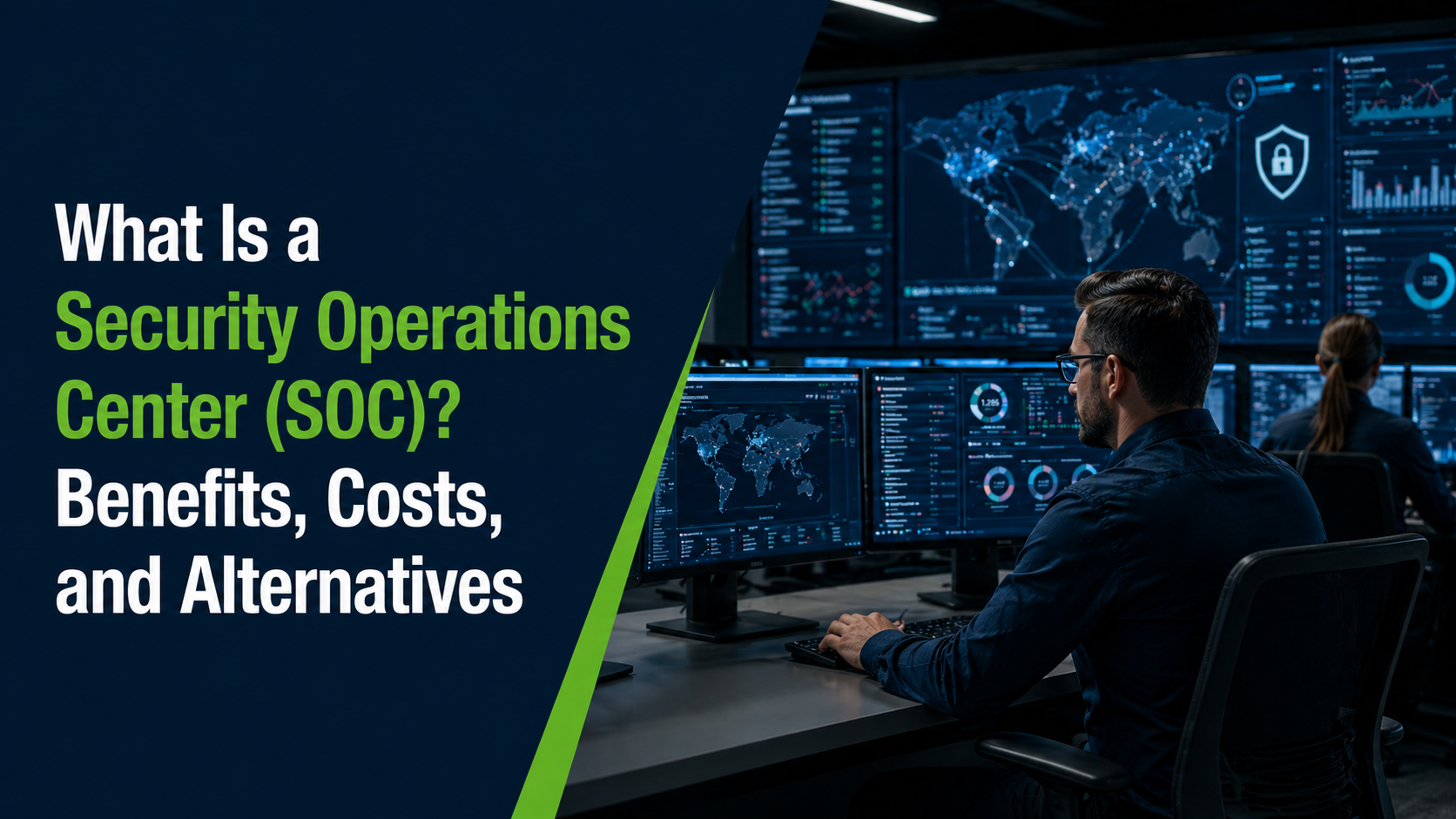
A Security Operations Center is your organization’s cybersecurity command post. It’s where threat detection happens in real-time, where incidents get handled before they become breaches, and where your security posture gets continuously improved.
But you don’t need a Fortune 500 budget to get Fortune 500 protection.
Most SMEs think a SOC means hiring a dozen analysts, building a 24/7 operations room, and spending millions annually. That misconception leaves businesses exposed. The truth? You have options that deliver the same threat detection and incident response capabilities without the enterprise price tag.
A SOC combines people, processes, and technology to monitor your networks, endpoints, and systems around the clock. It identifies threats, investigates alerts, responds to incidents, and prevents future attacks. Think of it as your cybersecurity team’s nerve center, where everything from firewall logs to endpoint alerts gets analyzed and acted upon.
The challenge isn’t whether you need these capabilities. You do. The challenge is choosing the right model for your organization’s size, budget, and risk profile.
This guide breaks down what a SOC actually does, who runs it, what it costs, and which alternatives make sense for businesses that can’t justify a full in-house operation. You’ll understand the core functions, the team structure, the technology stack, and most importantly, how to get SOC-level protection without SOC-level spending.
What a Security Operations Center Actually Does
A SOC isn’t just a monitoring room. It’s a coordinated system for detecting, analyzing, and responding to cybersecurity threats before they damage your business.
The core function is continuous monitoring. Your SOC watches traffic flowing across networks, tracks activity on endpoints, analyzes logs from servers and applications, and correlates events across your entire infrastructure. This happens 24/7 because cyberattacks don’t respect business hours.
Threat detection and threat intelligence work together in a modern SOC. Detection spots anomalies, unusual patterns, or known attack signatures. Intelligence provides context about emerging threats, attacker techniques, and vulnerabilities being actively exploited. Together, they help analysts separate real threats from false positives.
Incident response is where SOC value becomes obvious. When a threat gets detected, analysts investigate to determine scope and severity. They contain the incident, stop it from spreading, and remediate the damage. Organizations that detect and contain breaches within 30 days save an average of $1 million compared to longer response times.

Here’s what separates effective SOCs from security theater.
Proactive Threat Hunting
Waiting for alerts isn’t enough. Proactive threat hunting means actively searching your environment for threats that automated tools missed. Analysts look for indicators of compromise, unusual behavior patterns, and subtle signs of intrusion.
This is where experience matters. A skilled analyst knows what normal looks like for your environment and spots deviations that machines can’t flag.
Vulnerability Management
Your SOC identifies vulnerabilities across your infrastructure, prioritizes them based on risk and exploitability, and coordinates remediation. Not every vulnerability needs immediate patching. Some pose minimal risk to your specific environment. Others represent critical exposure.
Good SOC teams focus remediation efforts where they’ll have the biggest security impact.
Security Information and Event Management
SIEM technology aggregates logs and events from across your infrastructure into a single platform. Firewalls, servers, endpoints, cloud services, applications. Everything feeds into the SIEM, which correlates events, identifies patterns, and generates alerts.
Without SIEM, analysts would drown in disconnected data points. With it, they can spot coordinated attacks, track threat actor movement, and understand the full scope of incidents.
Compliance and Audit Support
Regulatory frameworks require continuous monitoring, incident response capabilities, and detailed security logging. Your SOC provides the evidence auditors want. GDPR, HIPAA, PCI DSS, SOC 2. Whatever compliance requirements you face, a functioning SOC makes demonstrating compliance substantially easier.
The documentation, logging, and incident records your SOC maintains become your audit trail.
Who Runs a Security Operations Center
SOC effectiveness depends entirely on the people operating it. Technology matters, but skilled analysts make the difference between detecting threats and missing them.
Most SOCs follow a tiered structure that balances expertise levels with operational needs.
Tier 1: Security Analysts
These are your front-line analysts. They monitor alerts, perform initial triage, and handle straightforward incidents. When an alert fires, Tier 1 analysts determine whether it’s a real threat or a false positive.
They escalate genuine threats to more senior analysts and close out false positives with proper documentation. This role requires strong attention to detail and the ability to follow established procedures under pressure.
Tier 2: Incident Responders
Mid-level analysts handle escalated incidents. They investigate deeper, correlate multiple data sources, and determine incident scope. When Tier 1 flags a potential breach, Tier 2 figures out what happened, how far it spread, and what needs to happen next.
These analysts need broader technical knowledge. They understand attack techniques, can analyze malware behavior, and know how threats move through networks.
Tier 3: Threat Hunters and Senior Analysts
Senior analysts don’t wait for alerts. They actively hunt for threats that automated systems missed. They investigate complex incidents that junior analysts can’t solve. They develop detection rules, tune SIEM systems, and research emerging attack techniques.
This tier requires deep cybersecurity expertise and years of hands-on experience.
SOC Manager
The SOC manager oversees operations, manages the team, coordinates with other departments, and ensures the SOC meets its objectives. They handle staffing, training, tool selection, and budget management.
They also serve as the bridge between technical operations and business leadership.
Security Engineers
Engineers maintain the technology stack. They deploy new tools, integrate security systems, optimize SIEM configurations, and ensure everything works together. When analysts need new detection capabilities, engineers build them.
This role combines cybersecurity knowledge with strong technical implementation skills.
| Role | Primary Responsibility | Key Skills |
|---|---|---|
| Tier 1 Analyst | Alert monitoring and initial triage | Pattern recognition, process adherence |
| Tier 2 Analyst | Incident investigation and response | Forensics, threat analysis |
| Tier 3 Analyst | Threat hunting and complex investigations | Advanced techniques, research |
| SOC Manager | Team leadership and strategic oversight | Management, communication |
| Security Engineer | Tool deployment and integration | Technical implementation, automation |
The challenge? The global cybersecurity workforce shortage stands at 4.8 million unfilled positions. Finding qualified SOC analysts is difficult. Retaining them is harder.

Different Types of Security Operations Centers
Not every organization needs the same SOC model. Your size, budget, risk profile, and internal capabilities determine which approach makes sense.
In-House SOC
You build it, staff it, and run it yourself. Complete control over operations, tools, and processes. Direct oversight of your security team. Customization to your exact needs.
The drawback? In-house SOCs cost between $1-4 million annually to maintain. That includes salaries for a full team, technology licenses, training, and infrastructure.

This makes sense for large enterprises with substantial budgets and complex security requirements. For most SMEs, it’s financially unrealistic.
Outsourced SOC
A managed security service provider handles your SOC operations. They provide the analysts, technology, and processes. You get 24/7 monitoring and incident response without building internal capabilities.
Cost is predictable and substantially lower than in-house operations. You benefit from the provider’s expertise across multiple clients and threat environments.
The challenge is finding a provider that understands your business, integrates with your existing tools, and delivers genuinely responsive service.
Hybrid SOC
You maintain some internal security capabilities while outsourcing others. Common approach: internal team handles Tier 1 monitoring during business hours, while an MSSP provides after-hours coverage and advanced threat hunting.
64% of companies plan to outsource at least part of their SOC operations, recognizing that hybrid models balance control with cost-effectiveness.
This works well for mid-sized organizations that need some internal expertise but can’t justify a full in-house team.
Virtual SOC
Distributed team members work remotely rather than from a centralized operations center. Same capabilities as traditional SOCs, but without the physical facility.
This became more viable during the pandemic and remains attractive for organizations with distributed infrastructure or remote-first cultures.
Technology Stack: What Powers a SOC
People run the SOC. Technology gives them leverage.
Every effective SOC relies on core technologies that enable monitoring, detection, analysis, and response at scale.
Security Information and Event Management
SIEM platforms are the foundation. They collect logs and events from every security tool, correlate data across sources, identify patterns, and generate alerts.
Popular SIEM solutions include Splunk, Elastic Security, and Microsoft Sentinel. Each has strengths. The right choice depends on your infrastructure, budget, and team expertise.
SIEM effectiveness depends on proper configuration and tuning. Out-of-the-box deployments generate too many false positives and miss real threats.
Endpoint Detection and Response
EDR tools monitor endpoint activity, detect malicious behavior, and enable rapid response. They provide visibility into what’s happening on workstations, servers, and mobile devices.
When ransomware starts encrypting files or malware establishes persistence, EDR catches it. Tools like CrowdStrike Falcon and Microsoft Defender for Endpoint combine detection with automated response capabilities.
Network Detection and Response
NDR analyzes network traffic for threats that bypass endpoint protections. It spots lateral movement, data exfiltration, and command-and-control communications.
This is critical because sophisticated attackers often compromise endpoints, then move laterally through your network. NDR catches that movement.
Security Orchestration, Automation, and Response
SOAR platforms automate repetitive tasks and orchestrate response workflows. When a specific alert fires, SOAR can automatically gather additional context, query threat intelligence feeds, and even execute initial containment steps.
This reduces analyst workload and speeds up response times. 71% of SOC analysts report burnout due to alert fatigue. Automation helps by handling low-level tasks and letting analysts focus on genuine threats.
Threat Intelligence Platforms
TIP solutions aggregate threat intelligence from multiple sources, provide context about emerging threats, and help analysts understand what they’re seeing.
When your SIEM flags suspicious traffic to an unknown IP address, threat intelligence tells you whether that IP is associated with known malware campaigns, state-sponsored actors, or legitimate services.
Vulnerability Scanners
Regular vulnerability scanning identifies weaknesses before attackers exploit them. Nessus, Qualys, and similar tools scan your infrastructure, identify vulnerabilities, and help prioritize remediation.
Your SOC uses vulnerability data to understand exposure and focus protection efforts where they matter most.
Why Organizations Implement SOCs
You implement a SOC to reduce risk. Everything else flows from that.
Faster Threat Detection
Threats that go undetected for weeks or months cause exponentially more damage than threats caught in hours. A functioning SOC shrinks detection time from weeks to minutes.
That speed difference determines whether a breach becomes a minor incident or a business-ending crisis.
Better Incident Response
Having trained analysts and established processes means incidents get handled properly. No scrambling to figure out what to do. No critical steps missed. No delays while you find external help.
Response speed and quality directly impact breach costs.
Improved Security Posture
Continuous monitoring reveals gaps in your defenses. Your SOC identifies where protection is weak, where visibility is missing, and where processes break down.
Over time, this feedback loop strengthens your entire security program.
Regulatory Compliance
Many frameworks require continuous monitoring and incident response capabilities. A SOC provides both, along with the documentation auditors demand.
This isn’t just about checking boxes. Compliance requirements exist because they reduce risk. A SOC that meets compliance standards also genuinely improves security.
Proactive Defense
Proactive cybersecurity means finding and fixing problems before they’re exploited. Your SOC provides that capability through threat hunting, vulnerability management, and continuous improvement.
Reactive security waits for attacks to happen. Proactive security prevents them.
How a SOC Operates Daily
Understanding daily SOC operations helps you evaluate whether you need these capabilities and how to get them.
A typical day starts with shift handoff. Outgoing analysts brief incoming analysts on active incidents, ongoing investigations, and emerging threats. Nothing gets lost between shifts.
Analysts monitor dashboards showing alert queues, system health, and threat feeds. When alerts fire, they investigate. Most alerts are false positives. Analysts close these quickly with proper documentation.
Real threats get escalated. Tier 2 analysts investigate deeper, determine scope, and coordinate response. Critical incidents involve the entire team, security engineers, and business stakeholders.
Alert Triage
This is the front-line activity. Analysts review alerts, gather context, and determine whether each represents a genuine threat.
The challenge? 40% of alerts never get investigated due to volume and staffing constraints. And 60% of security teams reported that an ignored alert later proved critical.

Effective triage requires good tools, clear processes, and experienced analysts who know what matters.
Incident Investigation
When something suspicious surfaces, analysts dig in. They examine logs, correlate events, analyze affected systems, and reconstruct what happened.
This is detective work. Good analysts follow evidence, question assumptions, and build complete pictures of incidents.
Threat Containment
Once an incident is confirmed, containment happens fast. Isolate compromised systems. Block malicious traffic. Disable compromised accounts. Stop the threat from spreading.
Speed matters here. Every minute of delay gives attackers more time to move laterally, steal data, or deploy ransomware.
Remediation and Recovery
After containment, the SOC coordinates cleanup. Remove malware. Patch vulnerabilities. Restore systems from clean backups. Verify that threats are completely eliminated.
This phase requires coordination with IT teams, system administrators, and business units.
Post-Incident Review
Every significant incident ends with lessons learned. What worked? What failed? How can detection improve? What process gaps need fixing?
This continuous improvement cycle strengthens your security posture over time.
The Real Cost of Running a SOC
Budget constraints are why most SMEs can’t build in-house SOCs. Understanding costs helps you evaluate alternatives.
Staffing Costs
You need minimum coverage during business hours. Better coverage means 24/7 monitoring. That requires multiple shifts and redundancy for vacations and sick leave.
A basic team might include four Tier 1 analysts, two Tier 2 analysts, one senior analyst, one manager, and one engineer. Salaries vary by location, but cybersecurity professionals command premium pay.
Annual staffing costs easily exceed $800,000 for a small team.
Technology Licenses
SIEM, EDR, NDR, SOAR, threat intelligence feeds, vulnerability scanners. Enterprise security tools aren’t cheap. Annual licensing for a complete SOC technology stack runs $200,000 to $500,000 depending on organization size.
Those costs scale with the number of users, devices, and data volume.
Infrastructure and Facilities
Physical SOC facilities require secure space, redundant power, network connectivity, and monitoring displays. Even virtual SOCs need robust infrastructure for logging, analysis, and storage.
Add another $100,000 to $300,000 annually for infrastructure.
Training and Development
Cybersecurity evolves constantly. Your team needs ongoing training to stay current with new threats, attack techniques, and defensive tools.
Certifications, conferences, and training courses cost $50,000 to $100,000 annually for a team.
Total Annual Cost
Add it up and you understand why in-house SOCs cost $1-4 million yearly. Large enterprises justify this investment. Most SMEs can’t.
That doesn’t mean you go without SOC capabilities. It means you explore alternatives.
Alternatives to Building Your Own SOC
You need threat detection, monitoring, and incident response. You don’t necessarily need to build it yourself.
Security Operations Center as a Service
SOCaaS providers deliver complete SOC capabilities as a managed service. You get 24/7 monitoring, incident response, threat hunting, and vulnerability management without building internal capabilities.
Costs are predictable and dramatically lower than in-house operations. The SOCaaS market is projected to grow from $7.60 billion in 2025 to $21.19 billion by 2035 as more organizations recognize this makes financial sense.

The key is finding a provider that integrates smoothly with your existing infrastructure and delivers genuinely responsive service.
Managed Detection and Response
Managed security services focus specifically on detection and response rather than full SOC operations. Providers monitor your endpoints and networks, detect threats, and handle incident response.
MDR typically costs less than full SOCaaS because the scope is narrower. The MDR market is expected to grow from $5.09 billion in 2026 to $13.45 billion by 2031, driven by SME adoption.
This works well for organizations that handle some security internally but need expert help with detection and response.
Co-Managed SOC
You maintain an internal security team for strategic oversight and business-specific knowledge. An external provider handles 24/7 monitoring, advanced threat hunting, and after-hours incident response.
This balances internal control with external expertise and coverage. Your team focuses on high-value activities while the provider handles operational monitoring.
Virtual CISO Services
vCISO services provide strategic security leadership without a full-time executive hire. A vCISO designs your security program, coordinates with managed service providers, and ensures you’re getting appropriate protection for your risk profile.
This complements managed SOC services by providing the strategic layer that ties everything together.
Choosing the Right Approach
Your decision depends on budget, internal capabilities, risk profile, and compliance requirements.
When In-House Makes Sense
Large organizations with complex environments, strict compliance requirements, and budgets to support full teams. Enterprises handling highly sensitive data or operating in heavily regulated industries.
If you’re not in that category, look elsewhere.
When Outsourcing Makes Sense
SMEs that need SOC capabilities but can’t justify the cost of building them. Organizations without internal security expertise. Businesses that need 24/7 coverage without staffing multiple shifts.
Most SMEs fall into this category.
When Hybrid Makes Sense
Mid-sized organizations with some internal security capabilities but gaps in coverage or expertise. Companies that want strategic control while outsourcing operational tasks.
This works when you have security talent but need to extend their reach.
Questions to Ask Providers
Before selecting a managed SOC provider, get clear answers.
- What’s your average detection time for different threat types?
- How do you handle incident escalation and client communication?
- What tools and technologies do you use, and how do they integrate with our existing stack?
- What’s included in your base service versus add-ons?
- How do you measure and report on service quality?
Good providers answer these questions clearly and provide references from similar clients.
Implementation: Getting Started
Whether building in-house or outsourcing, implementation follows similar steps.
Assess Current Capabilities
Document what security tools, processes, and expertise you already have. Identify gaps between current state and what you need. Understanding your threat environment and risk exposure informs what capabilities matter most.
This assessment drives your requirements and helps you choose the right approach.
Define Requirements
What threats concern you most? What compliance requirements apply? What response times do you need? How much visibility do you want?
Clear requirements help you evaluate options and avoid paying for capabilities you don’t need.
Select Technology and Partners
Choose tools that fit your environment and integrate well. Select providers whose service model matches your needs. Verify they have relevant experience with organizations like yours.
Don’t just pick the cheapest option. Value comes from effective protection, not low prices.
Deploy and Integrate
Deploy monitoring tools across your infrastructure. Integrate with existing security systems. Configure SIEM and detection rules. Establish communication channels and escalation procedures.
Plan for a gradual rollout that doesn’t disrupt operations.
Train Your Team
Even with outsourced SOC services, your internal team needs training on procedures, communication protocols, and how to work with external analysts.
Everyone should understand their role when incidents occur.
Test and Refine
Run tabletop exercises. Simulate incidents. Test detection and response. Identify what works and what needs adjustment.
This validation phase reveals gaps before real incidents test your capabilities.
The Future: AI and Automation in SOC Operations
SOC operations are changing. Automation and artificial intelligence are reshaping how threat detection and response work.
77% of organizations have already adopted AI for cybersecurity, primarily in SOC operations. AI helps with alert triage, pattern recognition, and automating routine tasks.
This doesn’t eliminate the need for human analysts. It makes them more effective by handling low-level tasks and surfacing the threats that require human judgment.
Machine Learning for Detection
ML algorithms identify patterns in normal behavior and flag deviations. They detect threats that signature-based tools miss and adapt as attack techniques evolve.
This improves detection accuracy while reducing false positives.
Automated Response
When specific threats are detected, automated playbooks can execute initial response steps. Isolate compromised endpoints. Block malicious IPs. Disable suspicious accounts.
This speeds up response and reduces dwell time while analysts investigate deeper.
Analyst Augmentation
AI assists analysts rather than replacing them. It gathers context, suggests investigation paths, and automates evidence collection. Analysts focus on decision-making and complex problem-solving.
This addresses the staffing challenge by making each analyst more productive.
Common Pitfalls and How to Avoid Them
SOC implementations fail for predictable reasons. Avoid these mistakes.
Treating It as a Technology Project
A SOC is people, processes, and technology. Organizations that focus only on tools end up with expensive systems that don’t deliver security value.
Start with understanding what you’re trying to achieve, then select tools that support those goals.
Ignoring Process Development
Without clear processes for alert handling, escalation, and incident response, your SOC becomes chaotic. Analysts improvise. Critical steps get skipped. Response is inconsistent.
Document procedures before you need them.
Underestimating Staffing Needs
Thinking a single analyst can handle 24/7 monitoring is unrealistic. Effective risk management requires adequate resources.
Either staff properly or outsource to providers who can deliver continuous coverage.
Poor Tool Integration
Security tools that don’t share data or work together create analyst frustration and missed threats. Plan for integration from the start.
Choose tools that play well together or platforms that unify capabilities.
Neglecting Training
Even experienced analysts need training on your specific environment, tools, and processes. Skipping this leads to mistakes and slow response.
Invest in onboarding and ongoing training.

Making the Decision
You don’t need to match enterprise budgets to get enterprise-level protection.
A SOC provides critical capabilities: continuous monitoring, threat detection, incident response, and proactive defense. These capabilities reduce risk, speed up response, and improve your overall security posture.
The question isn’t whether you need these capabilities. The question is how to get them within your constraints.
For most SMEs, the answer is managed services. SOCaaS, MDR, or co-managed models deliver the protection you need without the costs you can’t justify. Pair that with strategic guidance from a vCISO, and you have a security program that protects your business without breaking your budget.
Start by assessing where you are. Understand your current security capabilities, identify gaps, and define what good looks like for your organization. Then evaluate options based on effectiveness, not just cost.
The threats are real. The consequences of inadequate protection are severe. But the path to better security doesn’t require unlimited budgets. It requires making smart choices about how to get the capabilities that matter.
What’s your biggest security concern right now? Where are the gaps in your current approach? Those answers point you toward the right solution.

