









A cybersecurity risk assessment report documents threats, vulnerabilities, and their business impact in clear terms executives can act on. The report drives security spending, insurance premiums, and compliance standing, not just IT policy. Effective reports follow a consistent structure covering asset inventory, threat identification, risk prioritization, and mitigation plans with defined owners and deadlines. The global average cost of a data breach in 2025 was USD 4.44 million, which makes documenting and addressing risks a financial imperative.

Most risk assessment reports get filed and forgotten because they’re written for security auditors, not decision-makers. The board doesn’t care about CVE identifiers. They care whether customer data is safe, whether the business can survive a ransomware attack, and what it costs to fix what’s broken.
I’ve watched SMEs waste weeks on risk assessments that don’t change behavior. The report sits in a folder. No budget gets allocated. No controls get implemented. That’s not a documentation problem. That’s a communication problem.
This guide shows you how to write a cybersecurity risk assessment report that gets read, understood, and acted on. You’ll learn the structure that works, the data that matters, and the language that bridges technical findings with business decisions. Whether you’re documenting for compliance, insurance, or internal planning, you’ll finish with a report that protects your organization.
What Is a Cybersecurity Risk Assessment Report
A cybersecurity risk assessment report documents the systematic process of identifying threats to your IT environment, evaluating vulnerabilities that could be exploited, and prioritizing risks based on their likelihood and potential business impact.
The report isn’t a technical audit. It’s a business document that translates security findings into decisions about resource allocation, control implementation, and risk acceptance. Think of it as a roadmap that tells leadership which fires to fight first and why.
Risk assessment reports typically follow a standard structure across organizations. The core components include an executive summary for non-technical stakeholders, detailed methodology explaining how risks were identified and measured, asset inventory listing systems and data in scope, threat and vulnerability analysis documenting specific risks, risk prioritization showing which issues matter most, and recommended security controls with implementation timelines.
The format matters less than the function. Your report needs to answer four questions executives actually ask:
- What’s at risk if we do nothing?
- How likely is each scenario?
- What will it cost to fix versus absorb the risk?
- Who’s responsible for each action?
Over 21,500 Common Vulnerabilities and Exposures (CVEs) were disclosed in the first half of 2025. Your report doesn’t need to catalog every CVE. It needs to explain which vulnerabilities actually threaten your specific assets and operations.
The best reports connect technical risks to business outcomes. Don’t just say “unpatched server.” Say “customer payment system vulnerable to ransomware, potential downtime cost $300K per hour based on revenue data.” That’s language decision-makers understand.
Why Cybersecurity Risk Assessment Reports Matter
Cybersecurity risk assessment reports serve as the foundation for every security decision your organization makes, from budget allocation to insurance coverage to incident response planning.
Without a documented risk assessment, you’re flying blind. You don’t know which systems matter most. You can’t justify security spending. You have no baseline to measure improvement. And when a breach happens, you can’t prove you exercised reasonable care.
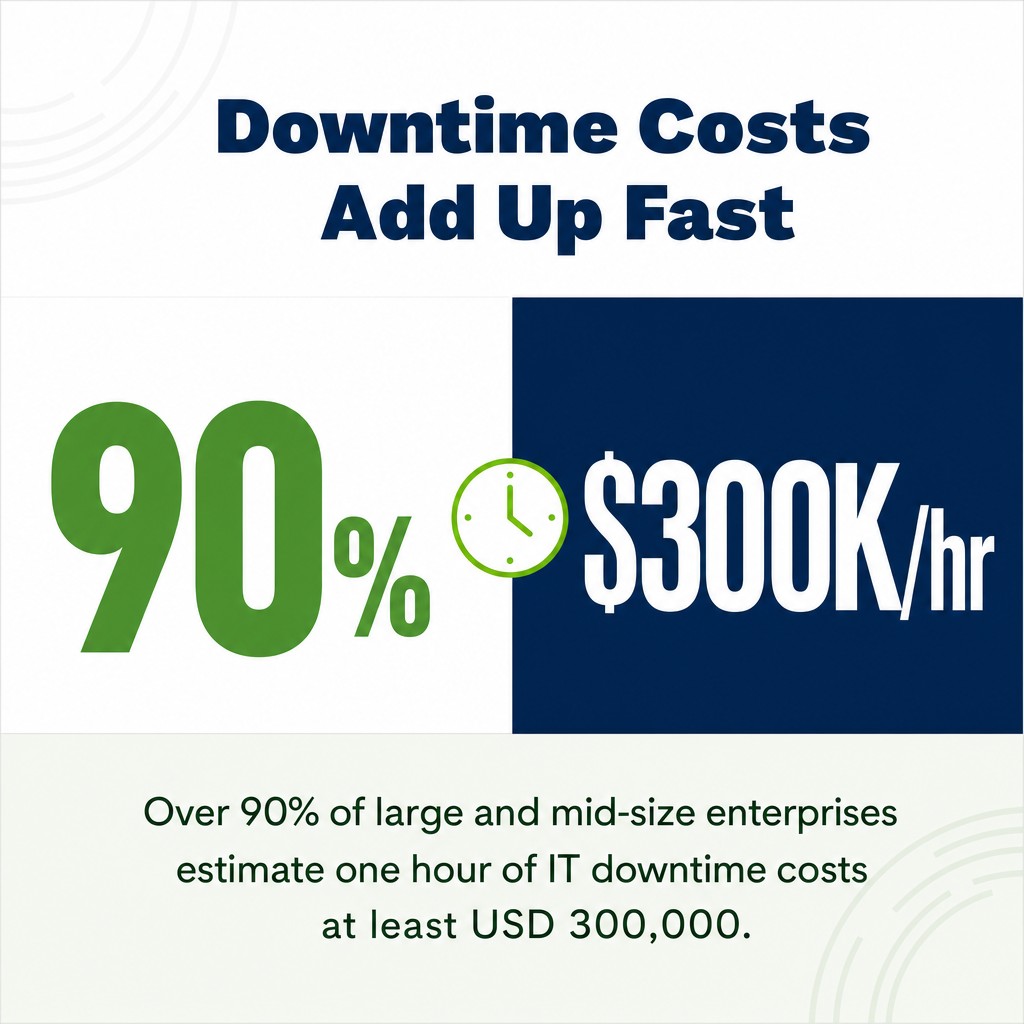
The business case is straightforward. Over 90% of large and mid-size enterprises estimate that a single hour of IT downtime costs them at least USD 300,000. Your risk assessment report identifies which systems, if compromised, would cause that downtime. That’s not theoretical risk. That’s budget justification.
Compliance and Legal Protection
Regulators demand documented risk assessments. The U.S. Securities and Exchange Commission (SEC) requires public companies to disclose significant cybersecurity incidents within four business days. You can’t disclose what’s “significant” unless you’ve assessed materiality in advance. GDPR can impose fines of up to EUR 20 million or 4% of global annual turnover for serious security failures, and regulators specifically look for evidence of proactive risk management.
Legal teams love documented risk assessments because they demonstrate due diligence. If you get sued after a breach, your risk assessment report shows you identified the risk, proposed controls, and documented decisions. That’s the difference between negligence and informed risk acceptance.
Insurance Requirements and Premium Reduction
Cyber insurance underwriters now require risk assessment documentation before issuing policies. The number of cyber insurance policies in force in the U.S. remained flat in 2024 at about 4.37 million, with reported claims rising nearly 40%. Insurers respond by demanding proof you’ve identified and addressed basic risks before they’ll cover you.
A solid risk assessment report can reduce your premiums. Insurers offer better rates when you demonstrate mature security practices. Document MFA implementation, backup testing, incident response plans, and employee training. Workforce multi-factor authentication (MFA) adoption reached 70% of users as of January 2025, which insurers now view as table stakes, not differentiators.
Strategic Security Planning
Risk assessment reports drive multi-year security roadmaps. You can’t plan what to build until you know what’s broken. The report identifies gaps between current controls and required protection, prioritizes projects based on risk reduction, and provides the business case for each investment.
Smart organizations revisit their risk assessment quarterly. Threats change. Your IT environment changes. New vulnerabilities emerge. A static report from last year doesn’t reflect today’s risk profile. The cadence matters as much as the content.
Key Components Every Risk Assessment Report Must Include
A complete cybersecurity risk assessment report requires seven core sections that work together to document risks, justify decisions, and guide implementation.
Each section serves a specific audience. Executives read the summary. Technical teams need the vulnerability details. Compliance officers want the framework mapping. Insurance underwriters look for control evidence. Your report structure should let each reader find what they need without wading through irrelevant content.
Executive Summary
The executive summary answers the “so what” question in plain business language. No jargon. No acronyms. No assumption of technical knowledge.
State the top three to five risks that could materially impact the business. Quantify each risk in financial terms wherever possible. Include the recommended action, estimated cost, and expected risk reduction. Add a one-paragraph assessment of overall security posture compared to industry peers.
Keep this section to one or two pages maximum. Most executives won’t read beyond it. Everything that follows supports the summary, but the summary must stand alone.
Scope and Methodology
The scope section defines boundaries. What systems, locations, and data types were assessed? What was explicitly excluded? Which business units participated? What time period does the assessment cover?
The methodology section explains how you identified and measured risk. Which framework did you follow? NIST, ISO 27001, CIS Controls? How did you calculate likelihood and impact scores? Who conducted interviews? What tools performed scans?
This section establishes credibility. When auditors or insurance underwriters review your report, they check whether your methodology follows accepted standards. Document your approach clearly so others can validate your findings.
Asset Inventory and Classification
You can’t protect what you don’t know you have. The asset inventory lists every system, application, and data repository in scope, organized by business criticality.
Start with crown jewel assets. What systems generate revenue? What data, if breached, would trigger regulatory notification? Where do you store customer PII? Approximately 48% of global data breach incidents in 2024 involved customer PII, which makes identifying where that data lives a priority.

| Asset Category | Business Impact | Examples |
|---|---|---|
| Critical systems | Revenue generation stops | Payment processing, e-commerce platform, core database |
| Sensitive data repositories | Regulatory penalties, reputation damage | Customer records, financial data, health information |
| Supporting infrastructure | Operations disrupted | Email servers, file shares, collaboration tools |
Classification drives prioritization. Not every asset deserves the same protection. Focus your security controls on assets that matter most to business continuity and compliance.
Threat and Vulnerability Analysis
The threat and vulnerability section documents specific risks discovered during assessment. For each finding, state the vulnerability clearly, explain which threat actors could exploit it, describe the attack scenario, and estimate likelihood and impact.
Threats come from multiple sources. External attackers target public-facing systems. Insiders abuse access privileges. An insider threat could lead to an average annual cost of USD 17.4 million per organization. Supply chain compromises arrive through trusted vendors. Your analysis should cover all relevant threat vectors.
Vulnerabilities aren’t just missing patches. Misconfigurations leave systems exposed. Weak authentication makes account takeovers trivial. Human error contributes to between 60% and 74% of cyber breaches, which means your vulnerability analysis must address people and processes, not just technology.

Use clear severity ratings. Critical vulnerabilities enable immediate exploitation with severe impact. High-severity issues require remediation within 30 days. Medium-severity findings get addressed in the next quarterly cycle. Low-severity items become backlog work.
Risk Scoring and Prioritization
Risk scoring translates technical findings into business decisions by multiplying likelihood ratings by impact scores to produce overall risk values.
Most frameworks use a simple matrix. Likelihood runs from rare to almost certain. Impact ranges from negligible to catastrophic. The intersection determines risk level and drives priority.
Customize the scoring model to your business context. A law firm cares more about confidentiality breaches than availability issues. A manufacturing operation prioritizes uptime over data protection. Weight your impact scores to reflect what actually matters to your organization.
Document both inherent risk and residual risk. Inherent risk is the exposure before controls. Residual risk is what remains after implementing mitigations. The gap between them justifies your security roadmap.
Recommended Controls and Mitigation Plans
The controls section prescribes specific actions to reduce risk to acceptable levels. For each high-priority risk, recommend a security control, estimate implementation cost and timeline, assign an owner, and project the residual risk after implementation.
Map controls to recognized frameworks. ISO/IEC 27001 certification is valued by customers as evidence of security maturity. Reference NIST CSF, CIS Controls, or ISO 27001 control families so stakeholders understand you’re following industry standards, not making up arbitrary requirements.
Practical mitigation examples include implementing MFA for all remote access to reduce account compromise risk, deploying endpoint detection and response on critical systems to limit ransomware impact, conducting quarterly security awareness training to address the human error that drives most breaches, establishing offline backups with monthly restore testing to ensure business continuity, and segmenting networks to contain lateral movement after initial compromise.
Be specific about implementation. “Improve security” means nothing. “Deploy MFA to all VPN users by end of Q2” is actionable. Include who pays for it, who builds it, and who maintains it after go-live.
Risk Register and Tracking
The risk register is your central tracking document. Every identified risk gets a unique ID, description, current status, assigned owner, target remediation date, and actual completion date once addressed.
This section turns your assessment from a point-in-time snapshot into an ongoing risk management program. Update the register monthly. Track which risks got mitigated, which got accepted, which got transferred through insurance, and which remain open.
The register also provides audit evidence. When regulators or auditors ask how you manage security risk, you hand them the register. It shows you’re not just identifying problems, you’re systematically addressing them.
How to Structure Your Risk Assessment Report for Maximum Impact
The structure of your cybersecurity risk assessment report determines whether it drives action or gets ignored, regardless of how thorough your analysis was.
Most technical teams write reports for other technical people. That’s why reports die in inbox folders. You need to write for multiple audiences simultaneously, each with different priorities and attention spans.
Front-Load the Business Impact
Start every section with business consequences, not technical details. Instead of “SQL injection vulnerability in web application,” write “customer database accessible to attackers, exposing 50,000 records subject to GDPR notification requirements, estimated response cost EUR 200K.”

Put dollar figures on everything you can quantify. Downtime cost per hour. Data breach notification expenses. Regulatory penalties. Reputation damage. Lost revenue. When you frame risk in financial terms, you speak the language executives understand.
Use the executive summary to tell the complete story. Assume your CEO reads only that section. Does it explain the current state of security? Does it identify the most serious gaps? Does it recommend specific actions with costs and timelines? If not, rewrite it.
Layer Technical Details Appropriately
Technical staff need implementation details, but those details should live in appendices, not the main report. The body of your report describes what needs fixing and why. The appendix lists CVE numbers, CVSS scores, affected systems, and remediation procedures.
This layered approach lets each reader consume the appropriate level of detail. Executives read the summary and scan the recommendations. IT managers review the full risk analysis. Security engineers dive into the technical appendix for patch schedules and configuration changes.
Use tables and charts to present complex data efficiently. A risk heat map shows at a glance which issues fall into critical, high, medium, and low categories. A trend chart demonstrates whether your security posture is improving over time.
Make Recommendations Actionable
Vague recommendations doom reports to irrelevance. “Enhance security controls” tells nobody what to do. “Deploy CrowdStrike EDR to servers handling customer data by March 31, budget USD 15K annual subscription” is specific enough to execute.
Each recommendation needs five elements. The specific control to implement. The systems or processes it applies to. The person or team responsible for implementation. The target completion date. The estimated cost including licensing, labor, and ongoing maintenance.
Prioritize ruthlessly. Don’t recommend 50 improvements and expect leadership to sort through them. Identify the three to five actions that will reduce the most risk for the least cost, then present those front and center. Additional recommendations can live in a backlog section for future consideration.
Connect to Business Objectives
Frame every risk in terms of business impact. A law firm cares about client confidentiality and regulatory compliance. Link security findings to attorney-client privilege breaches and bar association requirements. A healthcare provider worries about HIPAA violations and patient trust. Connect vulnerabilities to those concerns.
Reference strategic initiatives when recommending controls. If the company is pursuing enterprise customers who require SOC 2 certification, explain which controls directly support that goal. If expansion into European markets is planned, highlight GDPR-related risks and mitigations.
This approach transforms your report from an IT document into a business enabler. Security isn’t overhead. It’s the foundation for growth, customer trust, and operational resilience.
Step-by-Step Process for Writing Your Risk Assessment Report
Writing a cybersecurity risk assessment report follows a clear sequence that transforms raw security findings into executive-level business documentation.
The process takes most SMEs two to four weeks from initial scoping to final delivery, depending on environment complexity and resource availability. Rushing produces shallow analysis. Taking too long creates stale findings that no longer reflect current risks.
Gather and Organize Assessment Data
Pull together all data sources before you start writing. Vulnerability scan reports from tools like Nessus or Rapid7. Penetration test results. Access review logs. Security awareness training metrics. Incident response records. Asset inventory spreadsheets.
Organize findings by asset or business process, not by tool. All vulnerabilities affecting the customer database go in one section. All risks related to remote access go in another. This structure matches how business leaders think about their operations.
Validate technical findings before including them in the report. False positives waste everyone’s time. If a scan flags a critical vulnerability on a system that’s actually isolated and not accessible from the internet, adjust the risk rating accordingly. Context matters more than raw scan output.
Calculate and Document Risk Scores
Apply your chosen risk framework consistently across all findings. If you’re using NIST, follow their likelihood and impact definitions exactly. If you’re using ISO 27005, stick to that methodology. Mixing frameworks mid-report confuses readers and undermines credibility.
Create a scoring rubric table that explains exactly how you rate likelihood and impact. This transparency lets stakeholders understand why you rated one risk critical and another medium. It also provides a reference for future assessments so scoring stays consistent over time.
| Likelihood | Impact Level | Overall Risk |
|---|---|---|
| Almost certain (monthly events) | Catastrophic (business-ending) | Critical: Address immediately |
| Likely (quarterly events) | Major (significant financial/reputation damage) | High: Remediate within 30 days |
| Possible (annual events) | Moderate (temporary disruption) | Medium: Address in quarterly cycle |
For each scored risk, document your reasoning. Why did you rate likelihood as “likely” instead of “possible”? What makes the impact “major” rather than “moderate”? These justifications defend your conclusions during stakeholder reviews.
Draft the Executive Summary Last
The executive summary appears first but gets written last. You can’t summarize findings you haven’t fully analyzed yet. Write the detailed sections first, then distill the key points into summary form.
The summary should fit on one page if possible, two pages maximum. State overall security posture in one sentence. List the top three to five risks with their business impact. Recommend the most critical actions with costs and timelines. Include a statement about compliance status if relevant.
Read the summary out loud. If it takes more than two minutes to read, it’s too long. Busy executives give you that much time, maybe less. Make every word count.
Build Out Technical Sections with Supporting Evidence
The body of your report provides the detailed analysis that supports your summary conclusions. For each major risk category, describe the specific vulnerabilities discovered, explain which threats could exploit them, analyze the potential business impact, document existing controls that provide partial protection, and recommend additional controls to reduce residual risk.
Include evidence for every claim. Reference specific scan results. Quote relevant compliance requirements. Cite industry benchmarks. Cybersecurity spending is projected to reach USD 240 billion in 2026, which provides context for your budget recommendations. You’re not asking for unreasonable investments. You’re aligning with where the market is headed.
Address cybersecurity threats systematically. External threats deserve attention, but don’t ignore insider risks. Don’t forget supply chain vulnerabilities. Modern attacks exploit trusted relationships and legitimate access as often as they exploit technical weaknesses.
Create a Clear Action Plan
The recommendations section converts analysis into execution. Group related actions into projects or workstreams. Don’t just list 30 individual tasks. Bundle related work so implementation teams understand dependencies and sequencing.
Assign clear owners to every recommendation. If nobody owns it, it won’t get done. Note that “IT department” isn’t an owner. “John Smith, Infrastructure Manager” is an owner who can be held accountable for delivery.
Sequence actions logically. Some controls are prerequisites for others. You need asset inventory before you can implement effective vulnerability management. You need network segmentation before microsegmentation makes sense. Show the progression so teams know where to start.
For organizations just beginning their security journey, start with foundational risk assessment practices before tackling advanced controls. Walking before running prevents wasted effort and failed implementations.
Using Frameworks and Templates to Accelerate Report Development
Cybersecurity frameworks provide pre-built structures that accelerate report development while ensuring you cover all necessary elements and align with industry standards.
Starting from scratch wastes time. Standard frameworks give you a proven structure, accepted terminology, control baselines, and risk rating methodologies. You customize the framework to your context instead of inventing everything yourself.
NIST Cybersecurity Framework for Risk Reporting
The NIST framework organizes security activities into five core functions: Identify, Protect, Detect, Respond, and Recover. Your risk assessment report naturally maps to these categories.
Under Identify, document your asset inventory and business context. Under Protect, analyze access controls and data security. Under Detect, assess monitoring capabilities and anomaly detection. Under Respond, evaluate incident response preparedness. Under Recover, review backup and business continuity plans.
This structure keeps your report comprehensive. It also provides a common language that works across industries. When you tell stakeholders you’re following the NIST framework, they immediately understand your approach follows recognized best practices.
NIST also provides risk assessment guidance in SP 800-30, which details how to identify threats, assess vulnerabilities, and determine risk levels. Following this methodology makes your conclusions defensible and your recommendations credible.
ISO 27001 for Structured Risk Management
ISO 27001 requires a formal risk assessment as part of information security management. If your organization pursues ISO certification, your risk assessment report feeds directly into that process.
The ISO approach emphasizes systematic risk treatment. For each identified risk, you must decide whether to accept, avoid, transfer, or mitigate. That decision gets documented with clear justification. This structure forces disciplined thinking about risk tolerance and treatment options.
ISO also requires regular risk assessment updates. Your initial report isn’t a one-time project. It’s the foundation for ongoing risk management that gets reviewed at defined intervals.
Organizations pursuing certification should leverage established frameworks to ensure their assessment meets audit requirements from the start.
Risk Assessment Report Templates
Templates provide the skeleton. You supply the meat. A good template includes pre-formatted sections for all essential components, example risk descriptions you can customize, tables for asset inventory and risk register, and scoring rubrics you can adapt to your risk appetite.
Many cybersecurity risk assessment templates are available that provide starting structures. The key is choosing one aligned with your chosen framework and customizing it to reflect your specific business context.
Don’t just fill in blanks. Templates work best as guides, not rigid structures. If a section doesn’t add value for your audience, adjust or remove it. If your business needs additional context the template doesn’t provide, add that content.
The biggest benefit of templates is consistency. When you conduct quarterly risk assessments using the same template, stakeholders can immediately spot changes from the previous period. The format familiarity means readers focus on new findings instead of figuring out the structure.
Common Mistakes That Undermine Risk Assessment Reports
Most cybersecurity risk assessment reports fail not because of incomplete analysis but because of presentation failures that cause leadership to ignore or misunderstand critical findings.
Technical accuracy doesn’t guarantee business impact. I’ve reviewed reports with pristine methodology that produced zero security improvements because nobody could translate findings into decisions. Avoid these pitfalls.
Using Technical Language That Excludes Decision-Makers
The moment you write “critical CVSS 9.8 vulnerability in Apache Log4j allows remote code execution via JNDI lookup,” you’ve lost your CEO. Security teams understand that sentence. Executives don’t.
Translate technical findings into business impact. “Attackers can take full control of your customer database through a known vulnerability in widely publicized software. Customer data breach would trigger notification to 50,000 individuals under GDPR, estimated cost EUR 200K minimum.”
Save CVE numbers and technical details for appendices. The body of your report speaks business language. That doesn’t mean dumbing down. It means communicating clearly about what matters to non-technical stakeholders.
Define acronyms on first use. Not everyone knows that EDR means endpoint detection and response or that SIEM stands for security information and event management. Write for the smartest person in the room who isn’t a security professional.
Failing to Prioritize Effectively
Listing 50 findings with no clear prioritization overwhelms readers and diffuses focus. When everything is important, nothing is important. Leadership needs to know which three to five issues demand immediate attention.
Risk scoring helps, but it’s not enough. Two critical-rated findings might require very different responses. One might be fixable with a quick configuration change. The other might require months of re-architecture work. Call out the quick wins separately from the long-term projects.
Learning from common assessment mistakes helps teams focus their efforts on findings that actually move the security needle instead of trying to address everything at once.
Consider threat intelligence when prioritizing. The OWASP Top 10:2025 lists broken access control as the most critical web application security risk. If your assessment found access control issues, those deserve priority because attackers actively exploit them in real-world campaigns.
Presenting Findings Without Actionable Recommendations
Identifying problems without proposing solutions frustrates everyone. Your report shouldn’t just document risk. It should chart the path to reducing that risk to acceptable levels.
Each finding needs a specific remediation recommendation. Not “improve access controls.” Instead: “Implement multi-factor authentication for all remote access within 60 days using Duo or similar solution, estimated cost USD 8K annually for 100 users.”
Include both immediate tactical fixes and longer-term strategic improvements. You can patch the vulnerable server today. You need three months to replace the legacy application that requires running that server. Document both actions so stakeholders understand the full picture.
Link recommendations to resources. Saying “conduct security awareness training” is incomplete. Say “deploy KnowBe4 or similar platform to deliver monthly phishing simulations and quarterly formal training, assign to HR director, budget USD 12K annually.” That’s actionable.
Ignoring Business Context and Risk Appetite
Not every organization needs the same security controls. A financial services firm handling millions in daily transactions requires different protections than a five-person consulting company.
Calibrate your recommendations to the organization’s risk appetite, compliance requirements, budget constraints, and technical capabilities. Don’t recommend a security operations center to a 20-person startup. Do recommend outsourced monitoring to an appropriate MSSP.
Acknowledge when risks fall below the treatment threshold. Some low-severity findings don’t warrant remediation. Document them, rate them appropriately, and recommend accepting the risk. That’s valid risk management, not negligence.
Consider the organization’s maturity level. Understanding why assessments matter helps teams at different stages focus on appropriate controls. Don’t prescribe advanced threat hunting capabilities to an organization that hasn’t mastered basic patch management.
Producing Static Documents Instead of Living Programs
The biggest mistake is treating your risk assessment report as a compliance checkbox instead of a risk management tool. The report should launch an ongoing program, not sit in a folder until next year’s audit.
Build review cadences into your recommendations. Critical risks get reviewed monthly. High risks quarterly. Medium risks semi-annually. This keeps the risk register current and demonstrates continuous improvement to auditors and insurers.
Update the report when the environment changes significantly. New systems go live. Regulatory requirements change. New vulnerabilities emerge. AI-related systems face risks from adversarial attacks and model poisoning, which means organizations adopting AI tools need to reassess risks specific to those technologies.
Share progress against the risk treatment plan with leadership quarterly. Show which items got closed. Highlight what’s in progress. Flag anything blocked or delayed. This visibility turns your report from a static artifact into an active management tool.

Implementing and Maintaining Your Risk Assessment Program
A cybersecurity risk assessment report drives value only when organizations implement its recommendations and establish processes to keep risk analysis current as threats and environments evolve.
One-time assessments produce one-time benefits. Continuous risk management produces sustained security improvement and demonstrates the mature governance that regulators, insurers, and customers increasingly demand.
Building Executive Support and Budget Approval
Your report identifies work that needs funding. Getting that funding requires translating technical recommendations into business cases executives can approve.
Frame every request around risk reduction and business enablement. Don’t ask for USD 50K for security tools. Ask for USD 50K to prevent the USD 4.44 million average data breach cost. The math isn’t complicated when you present it clearly.
Tie security investments to strategic objectives. If the company wants enterprise customers, explain that those customers will require SOC 2 or ISO 27001 certification, which mandates specific controls. Security spending becomes revenue enablement, not overhead.
Present a phased approach when budgets are constrained. Identify which controls deliver maximum risk reduction for minimum cost. Implement those first, then tackle more expensive or complex projects in subsequent quarters. Progress matters more than perfection.
Tracking Implementation and Measuring Progress
The risk register becomes your implementation tracking tool. Every recommended control gets an entry with current status: not started, in progress, complete, or intentionally accepted without mitigation.
Update the register monthly. Assign clear owners who report progress during regular security review meetings. When items get stuck, escalate obstacles to leadership. Visibility drives accountability, which drives completion.
Measure progress quantitatively. Track the number of critical findings closed each quarter. Monitor how average time-to-remediate decreases as processes mature. Show the trend line of inherent risk decreasing over time as controls get implemented.
Use metrics that resonate with leadership. Reporting “deployed EDR to 95% of endpoints” means less to a CEO than “reduced ransomware risk from critical to low by deploying advanced detection across customer-facing systems.” Connect technical actions to risk reduction.
Scheduling Regular Assessment Updates
Your first risk assessment provides a baseline. Subsequent assessments track improvement and identify new risks introduced by environmental changes.
Most organizations should conduct formal risk assessments annually at minimum. Organizations in regulated industries or rapidly changing environments need quarterly assessments. Critical infrastructure operators might assess monthly for their most sensitive systems.
Smaller, focused assessments between major reviews keep findings current. When you deploy new cloud infrastructure, assess those systems before they go live. When you acquire another company, assess their IT environment during integration. Don’t wait for the annual cycle.
Build assessment schedules into your security program calendar. Make risk assessment a predictable process, not a scramble triggered by audit requirements. Mature organizations integrate continuous assessment into normal operations rather than treating it as a periodic project.
Adapting to Emerging Threats and Technologies
Threat landscapes shift constantly. Your risk assessment methodology needs to adapt as attack patterns evolve and new technologies enter your environment.
Review your threat model annually. What attack vectors matter this year that didn’t matter last year? Supply chain compromises became prominent. Ransomware tactics evolved. AI-generated phishing grew more sophisticated. Your assessment needs to address current threats, not just historically significant ones.
Assess new technologies before deploying them widely. Cloud migrations introduce new risks around data sovereignty and shared responsibility models. AI tools raise questions about data exposure and adversarial attacks. Remote work depends on secure access architecture. Each technology shift requires risk analysis specific to those capabilities.
Having the right assessment tools becomes increasingly important as environments grow more complex and distributed. Modern tools automate discovery and vulnerability identification, freeing analysts to focus on risk analysis and business communication.
Stay informed about regulatory changes. New compliance requirements introduce new risks around non-compliance. GDPR established strict breach notification timelines. SEC cybersecurity disclosure rules mandate incident reporting. State privacy laws proliferate. Your assessment must consider compliance risk alongside technical security risk.

